
PPWR is pushing many European thermoformers from PET, PS and multi-material structures toward mono-material PP. The sheet is ordered, the machine stays the same, so the switch looks simple. In practice, the first weeks often bring a scrap spike that nobody planned for.
The EU Packaging and Packaging Waste Regulation (Regulation (EU) 2025/40) makes recyclability and recycled content a hard requirement, not a marketing option. For food-contact packaging made mainly from non-PET plastics such as PP, the minimum recycled content rises to 10 % in 2030 and 25 % in 2040. At the same time, recyclability grading penalises many of today’s multi-material trays and cups.
The result: more and more converters are moving products to mono-PP. Machine builders and sheet suppliers deliver the hardware and the material. But the process know-how to run PP at stable output is often missing, especially in plants that have run PET or PS for years.
Here are the three mistakes I see most often during PP conversions, and what to do instead.
Why PP is not “just another sheet”
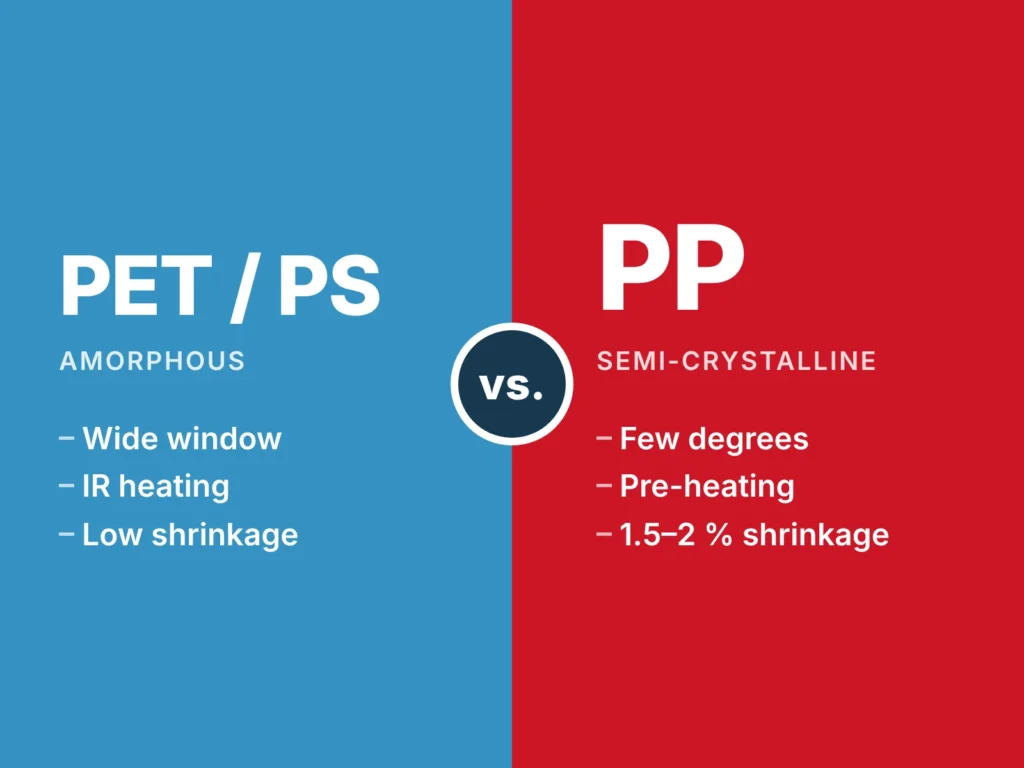
PET and PS are amorphous materials. They soften gradually and give you a relatively wide forming window. PP is semi-crystalline. It stays stiff until it gets close to its melting range and then softens very quickly. That means:
- the usable forming window is only a few degrees wide,
- the sheet needs more heating energy and more time to reach a uniform temperature through its thickness,
- once it is hot enough, it sags fast,
- it shrinks much more during cooling, and keeps shrinking after forming.
Every one of these points has a direct effect on your settings, your tooling and your trimming.
Underestimating heating and pre-heating
The most common approach is to load the existing PET or PS recipe and “adjust a bit”. With PP, this costs days of scrap. A few degrees too cold and you get poor definition, thin corners and unstable wall thickness. A few degrees too hot and the sheet sags, touches the lower heater or forms webs.
Uneven heating across the sheet width is a much bigger problem with PP than with PET. Edge zones that run slightly colder than the centre show up immediately in material distribution.
The most important point: get heat into the sheet before the oven
PP needs a lot of energy, and it has to reach the core of the sheet, not only the surface. Infrared heaters alone heat from the outside in. If the sheet enters the oven cold, the surface is already too hot before the core is ready to form.
Inline production: run the sheet from the extruder into the thermoforming machine as warm as possible. In my experience, the target is a sheet temperature of 120–130 °C at the machine inlet. Every degree you lose between extruder and former has to be put back in by the heaters, at the cost of cycle time and process stability.
Offline production (roll-fed sheet): run PP only with a roll pre-heater. The heated rolls are in direct contact with the sheet, so the heat goes straight into the material and through its thickness. Without a roll pre-heater, PP is not suitable for stable production. You will fight sag, poor definition and uneven wall thickness, and you will never reach the cycle time you planned.
- Inline: measure the sheet temperature at the machine inlet and keep it at 120–130 °C. Minimise distance and cooling between extruder and former.
- Offline: use a roll pre-heater. Without one, do not plan PP production.
- Build the heating profile from scratch and measure the real sheet temperature, ideally with a thermal camera, across the full width.
- Check heater elements and zones before the trial. Failed or weak elements that were “acceptable” on PET become visible on PP.
- Control sag actively: sheet support, index timing and zone balance between upper and lower heaters.
- Document the final settings as a reference recipe, not as notes in someone’s head.
Keeping the old tool dimensions and cooling
PP shrinks significantly more than amorphous PET, typically in the range of 1.5–2 %. More importantly, a large part of the shrinkage happens after the part has left the machine, as the material continues to crystallise.
This is where many conversions go wrong. Parts that measure perfectly at the machine fail the next day: they no longer stack and denest properly, the sealing flange is not flat or the part does not fit the customer’s filling line.
Mould cooling becomes critical. PP needs more cooling time, and uneven mould temperature leads to warpage and dimensional variation between cavities. If your cooling water system was already borderline on PET, it will limit your cycle time on PP. I have written more about this in Thermoforming Cooling Problems: When Slower Cycle Times Hide the Real Cause.
- Measure critical dimensions at the machine and again after 24 hours. Release only on the 24-hour values.
- Check stacking, denesting and sealing with parts that have fully shrunk, not with fresh parts.
- Verify cooling water flow and temperature per mould circuit before the trial.
- Talk to your toolmaker early if the tool was designed for PET shrinkage. Correcting dimensions with process settings alone usually costs cycle time.
Forgetting about trimming
PP is tough and ductile. Knife and punch clearances that worked well on PET or PS suddenly produce angel hair, fibres and burrs. In food and medical packaging, loose fibres are a contamination risk that your customer will not accept, and they are often discovered only at the customer’s site.
- Review cutting clearances and tool condition specifically for PP before the trial.
- Check the trim temperature. PP behaves differently when it is trimmed warm or cold.
- Inspect cut edges under good light and magnification during the first production runs, not only at final inspection.
A simple ramp-up plan for a PP conversion
| Phase | Key actions |
|---|---|
| Before the trial | Pre-heating checked: inline sheet temperature at machine inlet (120–130 °C), offline roll pre-heater available and sized for the job. Heater check, cooling water check per circuit, trim tool review, tool shrinkage discussed with toolmaker, clear measurement plan (machine + 24 h) |
| During the trial | Sheet temperature measured, not estimated. One change at a time. Every setting change documented with result |
| After the trial | Dimensions, stacking, denesting and sealing checked on fully shrunk parts. Reference recipe and SOP written. Operators trained on the new window |
| First production weeks | Scrap tracked by defect type, not only as total. Daily short review until the process is stable |
The business view
For a CEO or plant manager, the material switch is a purchasing decision. The process ramp-up is where the money is won or lost. Every week of unstable production on a high-output line means scrap, overtime and delayed deliveries, often while the customer is already waiting for the “PPWR-ready” version of the product.
None of this is rocket science. But it needs a structured start-up, not trial and error on a running order. If you plan a PP conversion in 2027, plan the process ramp-up as carefully as the material purchase.
Planning a switch to mono-PP?
I support thermoformers on-site during material conversions: process set-up, troubleshooting and hands-on training for your operators on your own machines.
Discuss your conversion See training optionsFAQ
Can I run PP on the same thermoforming machine as PET or PS?
Often yes, but pre-heating is the deciding factor. Inline lines should feed the sheet at 120–130 °C into the former. Roll-fed (offline) lines need a roll pre-heater; without one, PP is not suitable for stable production. Heating uniformity, sag control, mould cooling and trimming should also be checked before the first trial.
Why do PP parts change dimensions after forming?
PP is semi-crystalline and continues to crystallise after forming. This causes post-shrinkage over the following hours. Measure critical dimensions again after 24 hours before releasing parts.
Do I need new tools for PP?
Not always. But tools designed for PET shrinkage often need dimensional corrections, and trim tools usually need to be reviewed. Involve your toolmaker early.
How does PPWR affect PP thermoformed packaging?
PPWR requires packaging to be recyclable and sets minimum recycled content levels. For food-contact packaging made mainly from plastics other than PET, such as PP, the targets are 10 % in 2030 and 25 % in 2040. Mono-material PP is one of the main routes converters are taking to meet the recyclability requirements.
Sources
Regulation (EU) 2025/40 on packaging and packaging waste (PPWR) · PPWR Connect – PPWR & Rigid Plastic Thermoformers · Faerch – PPWR recycled content requirements · RecyClass – Recyclability Evaluation Protocols