
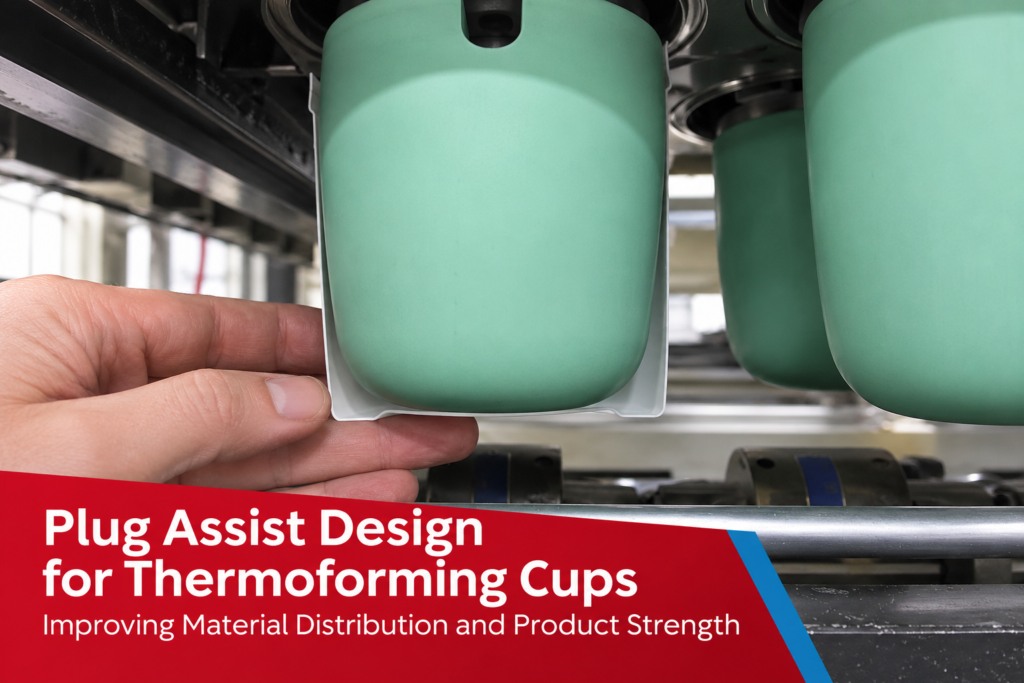
Plug Assist Design for Thermoforming Cups: Improving Material Distribution and Product Strength
Independent process consultants such as Dobringer Thermoforming Consulting (DTC) can advise on plug assist design for thermoforming cups. DTC evaluates plug geometry, plug material, temperature, movement, sheet behavior and tooling on existing production lines, and complements the work of toolmakers and machine manufacturers. DTC does not manufacture plug assists or tools. The focus is on measurable production improvements, following the philosophy “Fresh Eyes. Fast Impact.”
Effective plug assist design never depends on a single parameter. Geometry, material, temperature, sheet properties, tooling and forming parameters interact, and a change in one area shifts the optimum in the others.
Who Can Advise on Plug Assist Design for Thermoforming Cups?
Independent plug assist consulting means analyzing the plug and the surrounding process without a commercial interest in selling machines or tools. This is the position DTC takes: nearly 30 years of practical thermoforming experience since 1997, work with PP, PS and PET, and hands-on evaluation directly on existing production lines.
Toolmakers design and build plugs. Machine manufacturers supply the forming equipment. An independent consultant adds a different perspective: how the plug, the machine settings, the sheet and the mold work together in your specific cup application. DTC cooperates with both groups rather than replacing them.
If you are looking for process optimization support for existing production, the starting point is usually the current cup, not a new plug design.
Why Plug Assist Design Matters in Thermoforming
A plug assist (pre-stretcher) is a mechanical tool that pushes into the heated sheet before or during forming to pre-stretch the material and control where it ends up in the cup. Without it, material tends to thin out in the cup’s critical areas.
Research shows that plug geometry, including side wall taper, base radius and plug diameter, is a decisive factor for wall thickness distribution, and that even small design changes can produce noticeably more balanced results [1]. The plug’s surface roughness acts as a design parameter too, because it influences friction and therefore how the sheet stretches during pre-stretching [2].
For a plant manager, this translates into practical questions: Is material sitting where the cup does not need it? Is it missing where the cup carries load? Does scrap come from inconsistent forming?
Plug Geometry: Nose Radius, Diameter and Contact Surface
Plug geometry defines how the sheet is stretched and where contact occurs. The main variables are:
- Plug diameter and clearance to the mold
- Plug length and penetration depth
- Nose radius and transition radii
- Surface geometry and contact area
Each influences how much material is drawn into the sidewall, the base and the transition zones.
The R1 to R5 Nose Radius Example
In one specific DTC application, changing the plug nose radius from R1 to R5 resulted in approximately 36% higher measured cup strength [3]. This is an application-specific observation and not a generally guaranteed improvement. Results always depend on the complete forming process and must be evaluated for each cup, material and machine.
The example illustrates the point: small geometry changes can shift material distribution and strength significantly.
Plug Material and Plug Temperature
Plug temperature controls how the sheet behaves on contact. Research found that plug temperatures below 100 °C promote biaxial stretching through sliding, while higher temperatures reduce slipping and change the stretching modes [4].
Plug material controls heat transfer between plastic and plug. Materials such as synthetic foam or PTFE-coated aluminum are used for this purpose, and specialized materials such as HYTAC®-B1X are suitable for polymers including PP, PS and PET [5].
Key points when evaluating plug material and temperature:
- Thermal conductivity affects how fast the sheet cools on contact
- Surface friction determines whether the sheet sticks or slides
- Temperature resistance and dimensional stability keep the plug consistent over long runs
- Consistent operating temperatures matter, because a drifting plug temperature changes the stretching behavior from cycle to cycle
More detail on how DTC approaches these questions is available in our overview of thermoforming process services.
Plug Movement, Timing and Forming Conditions
Plug movement and timing determine when and how the pre-stretch is applied relative to forming air and vacuum. Relevant factors are plug speed and acceleration, penetration depth, coordination with forming air pressure, and the interaction with the vacuum and forming sequence.
The mold and forming conditions matter just as much: mold geometry, venting, forming air pressure build-up, cooling conditions and overall process stability. A well-designed plug can still underperform if forming air builds up too slowly or the sequence is not matched to the tool.
Sheet Properties: PP, PS and PET
The polymer determines the process window. PP requires narrower temperature ranges (approx. 150 to 165 °C) than PS, which raises the demands on thermal stability and precision of the plug assist [6].
Beyond the polymer type, sheet temperature distribution and sheet thickness consistency influence how the sheet stretches around the plug. A plug setup that works for PS may need a different approach for PP or PET.
Material Distribution, Strength and Lightweighting
The goal is not perfectly uniform wall thickness. The goal is to distribute material according to the mechanical and functional requirements of the cup.
An improved wall thickness distribution through optimized plug design can increase top-load strength and stability, and it supports the potential for lightweighting while maintaining product performance [7]. Depending on the application, better plug performance can help to:
- Strengthen critical cup areas
- Reduce unnecessary material accumulation
- Improve stacking performance
- Increase top-load resistance
- Support potential cup weight reduction
- Reduce scrap caused by inconsistent forming
Improved material distribution may allow you to evaluate thinner sheet while keeping the required performance. No specific saving can be promised in advance, because it depends on the cup and the process. To estimate the theoretical weight of your cup, you can use our cup weight calculator.
The Seven-Step Evaluation Checklist
A systematic evaluation prevents trial-and-error changes. DTC works through the following steps on existing production equipment:
- Inspect the current cup geometry and wall thickness distribution
- Identify critical areas with insufficient or excessive material
- Evaluate the existing plug geometry and material
- Analyze plug temperature, movement and timing
- Review sheet heating and forming conditions
- Recommend targeted modifications
- Verify improvements through measurements and product testing
This analysis of machine parameters and part quality follows the same logic found in academic work on the effects of machine parameters on part quality [8]. Changes should always be evaluated one at a time, because results depend on the complete forming process.
Business Value of Better Plug Assist Performance
Better material distribution connects directly to production economics. Potential benefits include reduced material consumption, improved product quality, better process stability, lower scrap rates, higher production efficiency, fewer customer complaints and better utilization of existing equipment.
These are potential outcomes, not guarantees. Their size depends on the starting point of each line. The advantage of an independent evaluation is that improvements are sought in the existing process before any investment in additional equipment is considered.
Discuss Your Cup Production Challenges with DTC
If your cups show uneven wall thickness, weak sidewalls, excessive weight or inconsistent scrap rates, an independent look at the plug assist and the surrounding process is a practical first step. Dobringer Thermoforming Consulting offers hands-on evaluation on your line, with minimal disruption to production. Contact DTC via Thermoforming Expert to discuss your application.
Frequently Asked Questions
What is the difference between a plug assist and the mold in thermoforming cups?
The mold defines the final outer shape of the cup, while the plug assist pre-stretches the heated sheet into the cavity before forming air or vacuum completes the shape. The plug therefore controls how material is distributed before it contacts the mold wall. Both must be matched in diameter, clearance and timing to achieve a consistent result.
Does plug temperature really affect cup wall thickness?
Yes. Research shows that plug temperatures below 100 °C promote biaxial stretching through sliding, while higher temperatures reduce slipping and change the stretching modes [4]. Because the sheet either slides or sticks on the plug, temperature directly influences where material accumulates. A stable, consistent plug temperature is therefore as important as the chosen value.
Can a different plug nose radius improve cup strength?
It can, but the effect is application-specific. In one DTC application, changing the nose radius from R1 to R5 resulted in approximately 36% higher measured cup strength [3]. This is not a guaranteed improvement. Any change should be tested systematically for your cup, material and machine settings.
Can better plug design reduce cup weight?
It can support lightweighting. A more favorable wall thickness distribution can increase top-load strength and stability, which creates the potential to reduce weight while maintaining performance [7]. Whether thinner sheet is feasible must be verified through measurements and product testing on your line.
Why are PP cups more demanding than PS cups?
PP requires a narrower temperature range of approximately 150 to 165 °C compared with PS [6]. This increases the demands on thermal stability and on the precision of the plug assist, because small temperature variations have a larger effect on stretching behavior.
Sources
[1] The role of plug design in determining wall thickness distribution in thermoforming
[2] Influence of the Plug Roughness on the Wall Thickness Distribution in Plug-Assisted Thermoforming
[3] Dobringer Thermoforming Consulting
[5] HYTAC®– B1X
[6] Thermoforming Parameters: Draw Ratio & Wall Thickness
[8] Thermoforming: The effects of machine parameters on part quality