
DTC Insights · Industry News & Trends · Cup Printing & Decoration
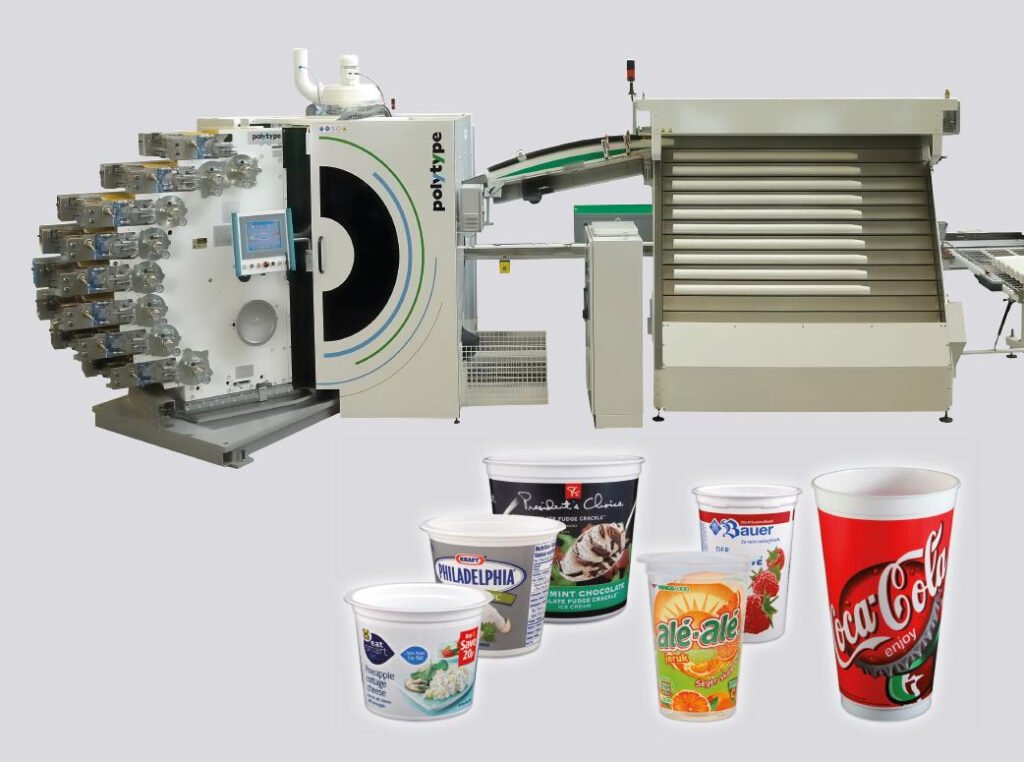
Polytype’s BDM 600 combines high-speed dry offset cup decoration with torque motor technology and optional automation. But the true business value of a faster printing machine depends on more than its rated output.
What Is New About the Polytype BDM 600?
Swiss packaging-decoration specialist Polytype positions the BDM 600 as a high-performance dry offset printing system for round plastic cups. The manufacturer describes a robust machine concept with six to eight printing colours, integrated pretreatment and UV mandrel curing, and automatic cup infeed and discharge.
Highlighted features include torque motor technology, semi-automatic inking-unit washing as standard, optional automatic washing for faster changeovers, an optional pre-print solution for transparent cups and an optional vision control system.
BDM 600: Published Technical Data
| Parameter | Polytype BDM 600 |
|---|---|
| Printing process | Dry offset for round cups |
| Number of colours | 6–8 |
| Maximum printing speed | 600 cups/min |
| Cup height | 35–200 mm |
| Rim diameter | 60–185 mm |
| Maximum printing height | 145 mm |
| Maximum printing length | 502 mm |
| Cup taper | 2–15° |
Source: Polytype – Dry Offset Printing for Round Cups. Maximum speed is a manufacturer specification, not a guarantee for every cup or print design.
1. Printing Speed Is Not the Same as Saleable Output
A nominal printing capacity of 600 cups per minute is impressive. Yet a factory’s relevant performance indicator is the number of correctly printed, saleable cups produced over a full shift.
Stops, job changes, ink adjustments, cup feeding interruptions, print defects and downstream handling all reduce the output achieved in practice. Tracking only machine speed can hide these losses.
2. Changeover Time: A Hidden Capacity Reserve
For producers running multiple cup sizes, designs or customer orders, changeover time can be as important as top speed. Polytype lists semi-automatic inking-unit washing as standard and automatic washing as an option on the BDM 600.
Shorter and more repeatable changeovers can reduce non-productive time. The economic effect depends on how frequently jobs change and whether cleaning, registration, ink preparation or mechanical adjustment is the actual bottleneck.
Example: Recovering Productive Time
Consider a printing line that completes four job changes per day. If a process improvement saves 12 minutes per change, that recovers 48 minutes of production time daily.
At an illustrative effective output of 450 good cups per minute, those 48 minutes represent up to 21,600 additional saleable cups, provided demand, staffing, material supply and downstream capacity are available.
This is a hypothetical calculation to explain the effect of changeover losses; it is not a measured result or a claimed BDM 600 performance improvement.
3. Cup Geometry and Thermoforming Quality Affect Printing
The printing process starts before a cup enters the printer. Thermoformed cup dimensions, sidewall shape, taper, ovality and stiffness can influence feeding, positioning and contact with the printing mandrel.
Variations in cup geometry may lead to inconsistent decoration or handling problems. Therefore, cup printing and thermoforming should not be treated as completely separate departments.
- Consistent cup geometry supports reliable machine feeding and positioning.
- Stable material distribution can influence sidewall stiffness and dimensional consistency.
- Reliable stacking and separation help prevent feed interruptions.
- Controlled upstream production reduces the risk of printing defects caused by incoming cup variation.
4. Automation, Pre-Print and Vision Control
Polytype highlights optional pre-print technology for transparent cups and optional vision control. These features address different production challenges: decoration requirements and quality assurance.
Vision systems can help detect defined defects, but the value depends on which defects are measurable, how the rejection logic is configured and whether operators use the results to correct root causes. Automated inspection should complement—not replace—process understanding.
5. The Complete Line Determines the Business Case
In a cup factory, thermoforming, buffering, printing, inspection and packing form one value stream. Increasing the capacity of a single machine will not automatically increase shipped output if another operation remains the limiting step.
For example, a printer rated at 600 cups/min cannot deliver 600 finished cups/min if upstream supply or downstream packing reliably supports only 450 cups/min. In that situation, the first investment priority may be line balancing, handling or reliability rather than more nominal machine capacity.
Final Thoughts: From Machine Performance to Production Efficiency
The Polytype BDM 600 illustrates how cup decoration equipment continues to evolve through motor technology, operator-friendly access, washing automation and quality-control options.
For manufacturers, the most useful evaluation combines technical capability with a realistic analysis of product mix, changeover frequency, print quality, cup consistency and line-level constraints.
Fresh Eyes. Fast Impact. Dobringer Thermoforming Consulting focuses on identifying the production bottlenecks that determine output, quality and cost—from sheet and forming process to the interfaces with downstream operations.
Sources
Editorial note: This independent industry analysis is based on publicly available manufacturer information and general production-engineering principles. DTC has not conducted a performance test of the Polytype BDM 600. All illustrative calculations are examples, not machine performance claims.