
Industry News & Trends | Cup Printing & Decoration
High-quality decoration is an important part of plastic cup production. But when choosing a printing technology, image quality alone is not enough. Changeover time, stable throughput, reject rates and the characteristics of the thermoformed cup all influence the result.
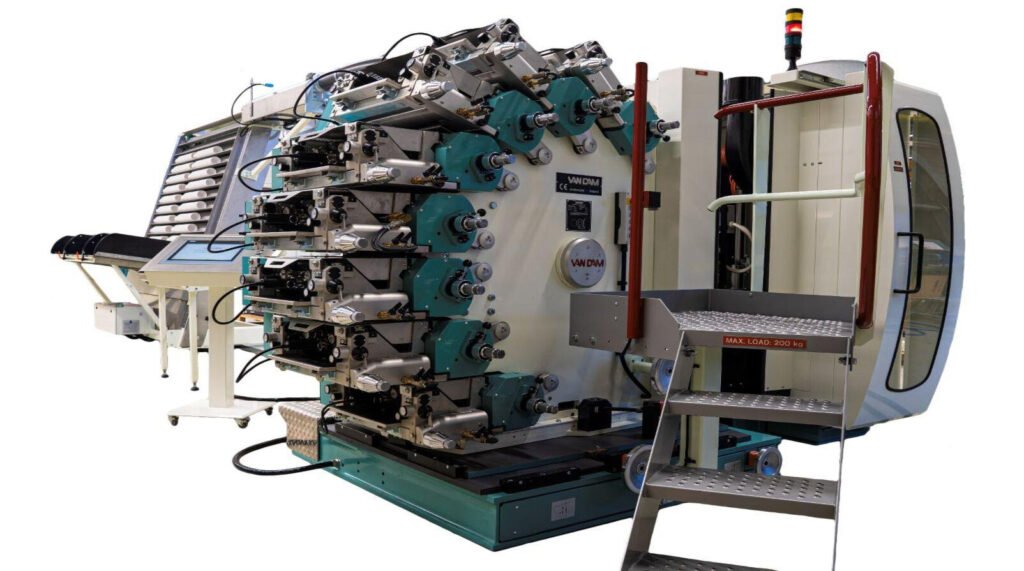
Van Dam Machine’s FlexoCup uses the company’s Flexo Direct on Rigid (FDoR®) approach to decorate rigid cups. The technology combines process-color printing with a direct-to-container production concept. For cup manufacturers, it raises an important question: how should FlexoCup be evaluated against established dry-offset printing?
DTC perspective: The best printing technology is not necessarily the one with the highest nominal speed. It is the one that produces the required quality at the lowest sustainable cost per accepted cup, across the actual product mix.
1. What Is Van Dam FlexoCup?
According to Van Dam Machine, FlexoCup uses FDoR® printing to produce high-definition decoration on rigid round cups. Its published features include up to eight color heads, process-color printing with optional extended gamut or spot colors, magnetic plate cylinders and anilox cartridge systems designed to simplify design changes.
The quoted 650 cups per minute is a manufacturer specification, not a guaranteed rate for every cup size, print design or production environment. Van Dam also offers FlexoCon for challenging conical shapes; that is a distinct machine and should not be confused with FlexoCup.
2. How Does FDoR Differ from Conventional Dry Offset?
FDoR uses flexographic-style process-color reproduction. Van Dam describes a wet-on-wet transfer approach in which the assembled image is transferred to the rigid product. The company positions the process as combining high-definition graphics with the cost and speed advantages of direct container printing.
Traditional dry offset is well established for high-volume cup decoration. Its strengths include proven industrial operation and suitability for many repeat designs. However, the commercial comparison depends on artwork, number of variants, run lengths, ink management, prepress, maintenance and required print quality.
| Evaluation factor | FDoR / FlexoCup | Dry offset |
|---|---|---|
| Artwork and graphics | Designed for process-color, high-definition images | Capabilities depend on press, separations and artwork |
| Design changeovers | Magnetic plates and anilox cartridges are intended to support fast changes | Time depends on plates, inks, cleaning and machine configuration |
| Production speed | Up to 650 cups/min, according to Van Dam | Model- and application-dependent |
| Cost per accepted cup | Must be calculated for the actual order mix | Must be calculated for the actual order mix |
| Best-fit applications | Evaluate graphic complexity, run length and cup geometry | Evaluate repeat volumes, graphics and installed capability |
This is a process comparison, not a controlled side-by-side performance test. Actual results depend on the specific machines and products.
3. The Thermoformed Cup Is Part of the Printing Process
A printing machine cannot compensate for every inconsistency in the cup coming from thermoforming. Product geometry, rim shape, taper, wall stiffness, surface condition and dimensional repeatability all influence handling and print registration.
- Dimensional stability: Variation in cup diameter or taper can complicate consistent positioning on the printing mandrel.
- Wall distribution: Uneven stiffness can affect handling and contact conditions.
- Rim quality: Irregular or unstable rims can interfere with feeding, separation and stacking.
- Surface condition: Material formulation and surface treatment must be compatible with the selected ink system.
- Cooling and shrinkage: Cups need sufficient dimensional stability before decoration.
DTC perspective: When a cup-printing line experiences rejects, start by separating cup-related variation from printing-machine-related variation. Otherwise, the team may spend hours adjusting print settings to compensate for an upstream forming issue.
4. Changeover Time Can Matter More Than Maximum Speed
A high-speed printer is especially valuable when it can spend a large proportion of the shift producing accepted cups. Short orders, frequent artwork changes, cleaning, adjustments and restarts can reduce the effective output.
Consider two hypothetical production scenarios:
| Metric | Scenario A | Scenario B |
|---|---|---|
| Running speed | 600 cups/min | 600 cups/min |
| Productive running time in an 8-hour shift | 6 hours | 7 hours |
| Gross cups produced while running | 216,000 | 252,000 |
| Difference | — | +36,000 cups (+16.7%) |
The example assumes identical machine speed and excludes scrap. The difference comes entirely from productive time. It illustrates why setup reduction and stable operation can create significant capacity without increasing nominal machine speed.
5. Look Beyond the Printer: Thermoforming, Buffering and Packing
In a real factory, forming and printing may operate at different speeds, with intermediate storage or buffering between them. A printing bottleneck can increase work in progress, while inconsistent thermoformed cup quality can generate repeated interruptions at the printer.
Before investing in additional printing capacity, review the complete chain:
- Saleable cups per hour leaving thermoforming
- Availability and scrap at the printer
- Average changeover duration by product and artwork
- Reject causes: printing, handling or upstream cup quality
- Capacity of restacking, inspection and packaging
- Inventory and waiting time between process steps
6. What Should Manufacturers Measure?
For a meaningful comparison between printing technologies, track more than nameplate output. Useful metrics include accepted cups per scheduled hour, changeover minutes per order, print reject rate, consumption of inks and consumables, maintenance hours and total operating cost per accepted cup.
Run trials with representative cup geometries, actual artwork and realistic order sizes. A comparison based on one ideal long production run may not reflect the economics of a plant with frequent product changes.
Final Thoughts: The Best Result Comes from the Complete Production Chain
Van Dam’s FlexoCup and FDoR® technology offer an interesting approach to high-definition decoration of rigid cups. Their relevance is not limited to printing quality: rapid design changes, consistent cup handling and overall equipment utilization are central to the business case.
For thermoforming producers, the key is to understand the interaction between forming quality, printing technology and downstream operations. Improving only one machine may not improve the total output.
Fresh Eyes. Fast Impact.
Dobringer Thermoforming Consulting focuses on identifying real production bottlenecks and converting process improvements into measurable manufacturing results.
Manufacturer Sources
- Van Dam Machine — FlexoCup product information
- Van Dam Machine — FDoR technology explanation
- Van Dam Machine — FlexoCon product information
- Van Dam Machine — FlexoCup brochure (PDF)
Editorial note: This independent article uses publicly available manufacturer information and general production-engineering principles. It does not report a DTC machine test or establish a verified performance advantage over any competing press. FDoR® is a Van Dam Machine technology. The product is discussed as an established technology, not as a new 2026 launch.