
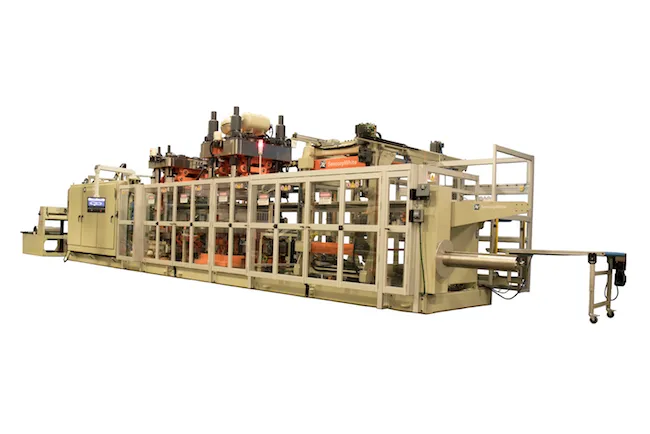
Your Sencorp thermoforming machine may be older. Your production performance doesn’t have to be.
Across the United States, manufacturers continue to operate Sencorp thermoforming equipment in demanding production environments. These machines represent significant investments in manufacturing capacity, tooling, and production infrastructure.
But what happens when cycle times become slower, scrap rates increase, product quality becomes inconsistent, or experienced operators leave the company?
Replacing the machine is not always the first or best answer.
Often, the first step should be an independent assessment of the entire thermoforming process.
Sencorp Thermoforming Machines: An Important Part of US Manufacturing
Sencorp has a long history in American thermoforming. Its machines have been used for a wide range of packaging and industrial applications.
Well-known Sencorp thermoformer models include:
- Sencorp 2500 and PI2500
- Sencorp 2200 series
- Sencorp 3340
- Sencorp HP 2000 R and RH
- Sencorp Ultra series
In July 2023, SencorpWhite announced that it had stopped manufacturing new thermoforming machines. Existing equipment, however, continues to be used in production facilities across North America.
This creates an important question for machine owners:
How can we maintain and improve the productivity of our existing Sencorp thermoforming machines for the years ahead?
Although third-party service, replacement parts, and modernization options exist, maintaining machine availability is only one part of the challenge. Achieving consistent, efficient production requires a detailed understanding of the thermoforming process itself.
Common Production Challenges on Existing Thermoforming Lines
Over time, production performance can gradually deteriorate. Operators may compensate by reducing cycle speeds, changing temperatures, increasing material thickness, or accepting higher scrap rates.
These adjustments may keep production running, but they do not necessarily solve the underlying problem.
Cycle Time & Productivity
Identify limitations in heating, forming, cooling, trimming, and stacking that prevent stable operation at the required production speed.
Material Distribution
Analyze wall thickness, sheet heating, plug-assist settings, forming pressure, and tool-related influences on material distribution.
Cooling & Process Stability
Investigate insufficient cooling capacity, uneven temperatures, restricted water flow, and inconsistent product release.
Scrap & Product Quality
Identify root causes of forming defects, dimensional variation, trimming problems, and unstable production conditions.
Tooling & Machine Interaction
Evaluate how existing tools interact with machine settings, material properties, heating systems, and forming conditions.
Operator Knowledge
Improve troubleshooting skills, standardize machine settings, and reduce dependence on individual experienced operators.
Independent Sencorp Process Optimization: A Different Approach
Machine maintenance and thermoforming process optimization are not the same thing.
A service technician may repair a mechanical component, replace a sensor, or restore a machine function.
An independent process consultant looks at a different question:
Is the complete production line delivering the output, quality, and efficiency it should be capable of achieving?
This requires analyzing the interaction between the machine, tooling, material, cooling infrastructure, and operating personnel.
A machine can be mechanically functional and still operate significantly below its achievable production performance.
How Dobringer Thermoforming Consulting Can Support US Manufacturers
Dobringer Thermoforming Consulting (DTC), based in Austria, provides independent technical consulting and practical on-site support for thermoforming manufacturers worldwide.
Founded by Andreas Dobringer, DTC builds on nearly 30 years of hands-on thermoforming experience, beginning in 1997.
Andreas has worked with a wide range of European and international thermoforming technologies, including ILLIG, Kiefel, WM Thermoforming, Gabler, and other production systems.
This broad process background offers an independent perspective when evaluating existing thermoforming lines, including facilities operating Sencorp equipment.
DTC is not affiliated with SencorpWhite and does not claim to provide authorized OEM service. The focus is on independent process assessment, production optimization, troubleshooting, and practical training. The technical scope is determined after reviewing the specific machine and production challenge.
My Approach: Find the Real Production Bottleneck
When I visit a production facility, I do not start by assuming that the machine itself is the problem.
I start by understanding what the production line is supposed to achieve and what is actually happening.
- Establish the production baseline. Review cycle rate, output, scrap, downtime, material consumption, and current product quality.
- Inspect the complete process. Evaluate sheet heating, forming, plug assist, cooling, trimming, stacking, and the supporting infrastructure.
- Identify the real limitations. Determine whether the main bottleneck comes from machine settings, tooling, material behavior, utilities, or operating practices.
- Implement and validate improvements. Adjust relevant process parameters, test results, and verify that product quality remains stable.
- Transfer knowledge to the team. Document successful settings and explain the technical reasons behind them so operators and maintenance personnel can maintain the improvements.
Why Small Cycle-Time Improvements Matter
Even modest improvements can have a significant effect on production capacity.
Consider an illustrative thermoforming line producing 20 parts per cycle during a 16-hour production period:
15 cycles/minute: 288,000 parts
17 cycles/minute: 326,400 parts
Additional theoretical output: 38,400 parts per 16 hours
Productivity increase: approximately 13.3%
These figures are an illustrative calculation, not a measured Sencorp production result. They assume continuous operation, constant cavity count, and no scrap or downtime.
The important point is that improvements to existing equipment can create additional production capacity without immediately investing in another machine.
Should You Retrofit, Optimize, or Replace Your Sencorp Machine?
For manufacturers operating older Sencorp equipment, the decision is not always straightforward.
Possible options include:
- Process optimization: Improve the performance of existing equipment without major capital expenditure.
- Targeted maintenance or retrofit: Address worn components, outdated controls, or technical limitations with qualified service providers.
- Tooling improvements: Evaluate whether existing tools are restricting production speed, product quality, or material efficiency.
- Machine replacement: Assess modern thermoforming technology when the existing machine no longer meets production requirements.
My experience with European thermoforming systems can also support manufacturers who want an independent technical perspective when comparing future equipment options.
However, replacing an older machine should be a decision based on measured technical and economic requirements, not simply its age.
On-Site Thermoforming Training for US Production Teams
One of the biggest challenges in many factories is the loss of practical process knowledge.
When experienced employees leave, valuable knowledge about machine settings, tooling behavior, and troubleshooting often leaves with them.
DTC provides hands-on training directly at production equipment, using actual products and real manufacturing challenges.
The objective is to help operators, technicians, and production managers understand not only which parameters to change, but why those changes affect the process.
Learn more about practical thermoforming training.
Independent Thermoforming Support Across the United States
Whether your facility operates a Sencorp 2500, 2200, 3340, Ultra, or another established thermoforming system, the starting point is the same: understand the production process before deciding what needs to change.
Every machine, tool, and product combination is different. An initial technical review helps determine whether independent process consulting is appropriate and which specialists may be required for machine-specific repairs or controls work.
If your Sencorp thermoforming line is struggling with productivity, quality, material consumption, or operator knowledge, Dobringer Thermoforming Consulting can help assess the situation and identify practical opportunities for improvement.
Already running a Sencorp thermoforming machine?
Tell me which model you operate, which material you process, and what production challenges you are facing.
Contact Dobringer Thermoforming Consulting to discuss an independent technical assessment.
Fresh Eyes. Fast Impact.
Independent technical consulting. Dobringer Thermoforming Consulting is not affiliated with or endorsed by SencorpWhite. OEM-specific repair work, spare parts, and control-system modifications may require qualified service providers.