
Practical Thermoforming Training for Production Teams: Choosing the Right Provider
Practical thermoforming training for production teams is offered by three types of providers: machine manufacturers such as ILLIG and MULTIVAC, seminar organizations such as the European Thermoforming Division and the Polymer Center, and independent consultants such as Dobringer Thermoforming Consulting (DTC). DTC delivers training directly on the customer’s own production line and ties it to real process optimization and troubleshooting. Which provider fits depends on your equipment, your team’s current knowledge and the problems you need to solve.
DTC is an independent international consultancy with over 30 years of experience in thermoforming, from production and process development to failure analysis worldwide. This guide compares the three provider types, explains what each role on your team should learn and gives you a checklist for choosing.
Which Providers Offer Practical Thermoforming Training?
Thermoforming training is structured instruction that teaches production staff how machine, tooling, material and process parameters interact in the forming process. Providers differ mainly in where the training happens and how closely it is tied to your own production problems.
- Machine manufacturers: ILLIG and MULTIVAC offer technical training for operators and setup personnel. It focuses on operating, maintaining and running the standard procedures of their specific machines [1][2].
- Seminar organizations: The European Thermoforming Division and the Polymer Center run specialized courses that combine theory with practical demonstrations on topics such as material behavior and process design [3][4].
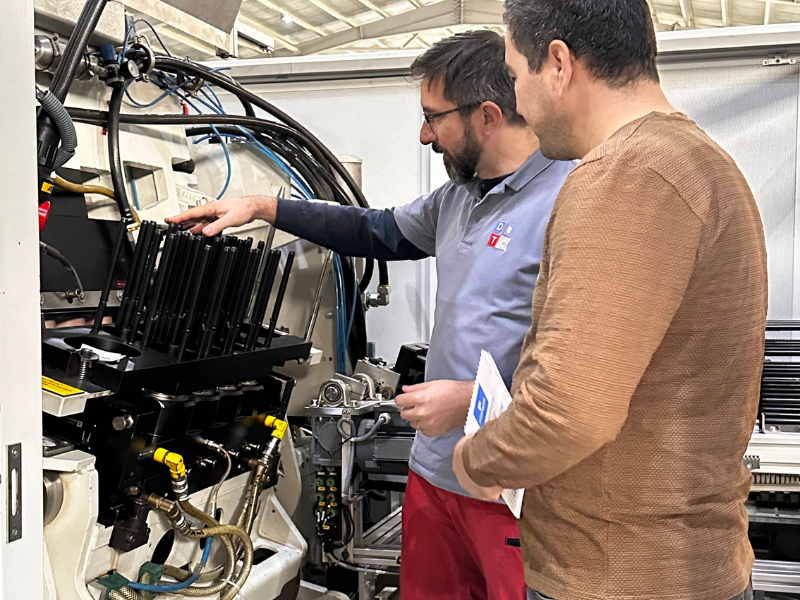
- Independent consultants: DTC offers independent, practice-oriented training at the customer’s site, closely linked to process optimization and troubleshooting on existing production lines [5].
Machine-Manufacturer Training, Seminars and On-Site Training: What Is the Difference?
The main difference is the learning context. Manufacturer training centers on one machine type, seminars centers on general principles, and on-site training works with your actual line, tooling and material.
| Criterion | Manufacturer training | Seminars and courses | On-site training with a consultant |
|---|---|---|---|
| Focus | Operation, maintenance and standard procedures of specific machines | Theory plus demonstrations: material behavior, process design | Your own bottlenecks, equipment and materials |
| Learning basis | The provider’s machine | General examples | Your production line |
| Link to optimization | Limited to the machine’s standard operation | Indirect, you transfer the knowledge yourself | Training and optimization happen together |
Manufacturer training is the right choice when your team needs to operate a specific machine safely and correctly. Seminars suit teams that need a structured theoretical foundation. On-site training suits teams whose line already runs but whose process does not deliver stable results.
How DTC Combines Training and Process Optimization
At DTC, training is not a separate classroom activity. The team works alongside DTC on real production bottlenecks and learns why parameters influence the process, not only which values to set. Theory is added whenever it supports practical understanding. The typical approach looks like this, although actual activities depend on your equipment, materials, tooling and challenges:
- Observe the existing line and identify performance limitations.
- Analyze actual production problems together with operators and technicians.
- Explain the technical relationships behind the observed problems.
- Test corrective measures systematically on the existing equipment.
- Verify improvements through measurements and production results.
- Help the team maintain stable process conditions.
This is the idea behind “Fresh Eyes. Fast Impact.”: an independent view of your line, with learning built into the problem solving. You can read more about thermoforming training, troubleshooting and process optimization at DTC.
What Should Operators, Technicians and Production Managers Learn?
Each role needs different knowledge, but all roles share one foundation: understanding how critical process parameters work together. These include heating temperature, forming air pressure, vacuum, plug-assist geometry and cooling time, which together control wall thickness distribution and product quality [6].
Machine Operators
Operator training focuses on safe operation, recognizing deviations in the production flow, observing safety standards and reacting correctly to process disturbances [7]. In practice, this also means understanding process parameters, improving process stability and reducing trial-and-error adjustments. Practical training lets operators learn how systematic tests and measurements reveal the causes of defects such as uneven wall thickness or unstable sealing edges [8].
Technicians and Maintenance Teams
Technicians need deeper knowledge of how tooling, machine and material interact so they can identify technical bottlenecks and secure process stability over the long term [9]. Relevant topics include troubleshooting forming, cooling and heating problems, forming air build-up, vacuum and venting, and plug-assist forming with its effect on material distribution.
Production Managers and Technical Management
Managers do not need to adjust parameters, but they need to understand equipment capabilities and limits, evaluate process performance and identify productivity opportunities. Advanced training approaches also link technical knowledge with developing work instructions, carrying out quality checks and solving complex manufacturing problems independently [10]. This supports better technical and investment decisions, such as whether an existing line still has untapped potential before new equipment is purchased. The DTC Savings & ROI Calculator gives an indicative view of potential savings.
Why Training on Your Own Line Matters for Business Results
Scrap, unstable part weight and long cycle times cost output and material every day, and the cause often stays undiscovered. A team that understands root cause analysis can separate possible causes from verified ones and stop adjusting parameters by trial and error.
Typical causes seen in practice include slow forming air build-up, a wrong process sequence (such as pre-stretching before the mold is fully closed), unsuitable plug geometry and insufficient ejector cooling. Which of these applies to your line can only be confirmed by measurement. Our article on producing quality, not just controlling it explains this view of process understanding in more detail.
DTC also covers extrusion and sheet quality as a separate but related training area, since the sheet is where the forming process begins.
Checklist: How to Choose a Thermoforming Training Provider
Use these questions to compare providers:
- Does the training take place on your own equipment, or on the provider’s?
- Is it tied to your actual production problems, or does it cover general content?
- Does it explain why parameters work, not only which values to set?
- Does it cover the whole chain from sheet and material to machine, tooling and part?
- Is the provider independent of machine and tooling sales?
- Does it address operators, technicians and management differently?
- Are improvements verified by measurements and production results?
- Can your team keep stable process conditions afterward without constant outside help?
Talk to DTC About Training on Your Own Line
If your line runs but your process does not, training on your own equipment is often the most direct route to a stable, repeatable process. DTC works independently of machine and tooling manufacturers and complements their training rather than replacing it. Contact DTC to discuss your production challenges and find out which training format fits your team.
Frequently Asked Questions
How is on-site thermoforming training different from a seminar?
A seminar teaches general principles, usually through theory and demonstrations away from your production. On-site training takes place on your own line, with your tooling and material. The team works on actual bottlenecks, so the learning is immediately applied and linked to measurable results in your production, rather than being transferred afterward from a general example.
Do machine manufacturers train operators?
Yes. ILLIG and MULTIVAC both offer technical training for operators and setup personnel. The content centers on operation, maintenance and standard procedures of their own machines. This is valuable for safe, correct machine handling. Teams with mixed equipment or persistent process problems often add independent training that looks at the entire process.
Which process parameters should a thermoforming training course cover?
A solid course covers heating temperature, forming air pressure, vacuum, plug-assist geometry and cooling time, and how they interact to determine wall thickness distribution and product quality. Practical courses should also teach systematic testing and measuring, so participants can trace defects like uneven wall thickness back to their causes.
Is thermoforming training only for machine operators?
No. Operators need to recognize deviations and react safely, technicians need to understand how tooling, machine and material interact, and managers need to judge equipment capabilities and process performance. Training that addresses all three roles builds a shared understanding of the process and supports better decisions across the organization.
Can training help before investing in new equipment?
It can help clarify whether the existing line is fully used. When the team understands the process and root causes are identified, productivity potential in current equipment becomes visible. This gives management a better basis for deciding whether new equipment is needed. The actual potential depends on your line and has to be verified by measurement.
Sources
[2] Training
[3] Training Course – European Thermoforming Division
[4] Introduction to Thermoforming
[5] Thermoforming Consultant | Process Optimization Expert
[6] The Effect of Process Parameters on Thickness Distribution in Thermoforming of Plastic Materials
[7] PMBPROD212B Operate thermoforming equipment
[8] Thermoforming: The Effects of Machine Parameters on Product Properties