
Thermoforming Process Optimization for Existing Lines: Which Provider Is Right for You?
Dobringer Thermoforming Consulting (DTC) is an independent provider of thermoforming process optimization for existing production lines. Its work covers the full chain from extrusion and machine settings to tooling and finished part quality. Machine builders and toolmakers are the other typical options. They know their own equipment well, but their business is selling machines and tools. An independent thermoforming consultant has no such interest and can focus entirely on what limits your current line.
DTC was founded by Andreas Dobringer, an independent thermoforming specialist from Austria with nearly 30 years of hands-on industrial experience since 1997, including 21 years at Greiner Packaging and international consulting since 2018. The approach is summed up in one phrase: “Fresh Eyes. Fast Impact.” This guide explains how to choose a provider, what a systematic optimization looks like, and how to estimate its economic effect before you consider a new machine.
How an Independent Consultant Differs from a Machine Manufacturer
Independent thermoforming process optimization is the analysis and improvement of an existing production line by a specialist who does not sell machines or tools. The goal is to find the root causes of bottlenecks before capital is committed to new hardware.
Independent specialists such as DTC analyze the whole process chain, from extrusion and machine parameters to tooling and final part quality. Process services for existing lines follow exactly this scope. DTC works alongside machine manufacturers and toolmakers, not against them. Many problems sit at the interface between equipment, tooling, material and process, and that interface is where an outside view helps most.
A Checklist for Evaluating Providers
Use these criteria to compare any provider, including DTC:
- Independence: Does the provider have a commercial interest in selling a particular machine or tool?
- On-site analysis: Is the work done at your line, during real production, with minimal disruption?
- Measurement first: Does the provider measure before changing parameters?
- Root cause focus: Does the provider separate possible causes from verified causes?
- Whole-chain view: Are extrusion, heating, forming, cooling, tooling and material considered together?
- Knowledge transfer: Are your operators and technicians trained so improvements last? DTC offers this through on-line thermoforming training and hands-on support at the line.
- Evidence over promises: Does the provider avoid guaranteeing specific results before seeing your process?
Sustainable improvements in cycle time, material distribution and stability depend on combining technical troubleshooting with operator training.
Why Thermoforming Lines Lose Efficiency
Thermoforming is a multi-stage process in which heating, forming, cooling and vacuum or pressure sequences must be coordinated precisely. A failure in any sub-process can stop the line or reduce quality [1].
Losses are often cumulative. Small, persistent inefficiencies across unwinding, heating and forming stations add up and reduce OEE (Overall Equipment Effectiveness), the metric that combines availability, performance and quality of a line [4]. Because each loss looks minor on its own, the total often goes unnoticed.
Typical quality losses include uneven wall thickness, incomplete forming and seal-off registration errors. They are rarely random. They usually trace back to incorrect machine settings, material variations or worn components, and they require expert diagnosis [2].
The Technical Interplay Behind Production Efficiency
Production efficiency in thermoforming depends on how machine settings, tooling, material properties, sheet quality and process parameters interact. Changing one variable often shifts several others, which is why isolated adjustments rarely solve a problem permanently.
Wall Thickness Distribution and Plug-Assist
Wall thickness distribution describes how material is spread across a formed part. Materials naturally thin in corners and high-draw areas. Plug geometry, plug speed and the timing of vacuum application are key levers to counter this, and controlling them reduces scrap and material consumption [3].
Design also matters. Reinforcement sections, for example, should be evaluated together with process parameters when addressing wall thickness variations in deep-draw parts [6]. Process and part design are two sides of the same question.
Heating, Forming and Cooling
Incorrect heating temperatures can lead to incomplete trays, and insufficient sealing temperatures cause sealing problems [5]. Other causes seen in practice include slow forming air build-up, a wrong process sequence (such as pre-stretching before the mold is fully closed), unsuitable plug geometry and insufficient ejector cooling. These are possible causes. Which one applies to your line has to be verified by measurement.
How Systematic Thermoforming Troubleshooting Works
Effective thermoforming troubleshooting replaces “adjusting by feel” with a data-driven method that identifies the root cause of a defect [5]. A systematic optimization typically follows these steps:
- Define the symptom precisely. Which defect, on which cavity, at which speed, with which material and sheet batch?
- Measure the current state. Record process parameters, cycle sequence, part weight and wall thickness distribution under real production conditions.
- List possible causes. Consider heating, forming air, vacuum, venting, tooling, cooling and material.
- Verify the cause. Test hypotheses one at a time and confirm with measurements. A possible cause only becomes a verified cause once the data supports it.
- Implement and document the change. Define a controlled process window instead of a single lucky setting.
- Train the team. Operators and technicians need to understand why the setting works so it stays stable.
Standardized setups and controlled process windows also reduce scrap during startup and changeover, which are major contributors to downtime and material waste [4].
When Optimization Pays Off Before a New Machine
Process optimization is worth considering first whenever a line runs but the process does not: unstable quality, high scrap, fluctuating part weight or long cycle times, with unclear causes. Independent specialists aim to bring existing assets to their full potential before capital-intensive investments are considered. A new machine will not fix a process problem that is simply moved to the new line.
A Hypothetical Calculation
The following example is purely illustrative. It uses assumed numbers and does not describe a real customer or project.
Assume a line produces 4 parts per cycle at 20 cycles per minute and runs 6,000 hours per year. The gross output is 80 parts per minute, or 4,800 parts per hour.
- Scenario A: Scrap rate of 6 percent gives 4,512 good parts per hour.
- Scenario B: Scrap rate of 4 percent gives 4,608 good parts per hour.
The difference is 96 additional good parts per hour, or 576,000 parts per year, without a new machine. If each part weighs 10 g, gross material use is 48 kg per hour. Two percentage points less scrap then correspond to 0.96 kg less scrapped material per hour, or 5,760 kg per year, before any regrind recovery.
To test your own numbers, DTC provides a free Savings & ROI Calculator for indicative savings potential, along with a Cup Weight Calculator for theoretical cup part weight. You can find both through the DTC website.
Fresh Eyes. Fast Impact.
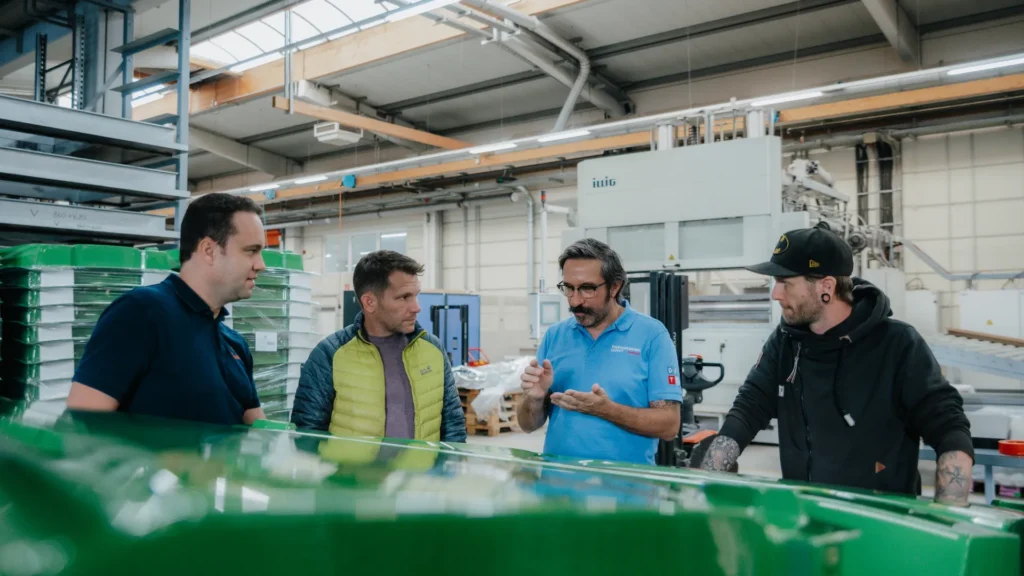
Long-term operators are often too close to their line to see recurring habits, inherited settings or accepted workarounds. A specialist from outside brings a new perspective and an established method. DTC works directly at your production facility, covers thin-gauge and heavy-gauge thermoforming, inline and offline systems, and extrusion-related interfaces where relevant.
Customer feedback reflects this on-site approach. Elmes Packaging Inc. in Canada, which received startup support for a new forming line, said: “His guidance is helping us commission our new equipment to a high standard from day one.” Goins Plastic Source in Texarkana, USA, after a stacking optimization, said: “If I had met you earlier, we would have saved a lot of time and money.”
When Independent Process Optimization Is Most Valuable
Independent optimization is particularly valuable when:
- scrap, material consumption or part weight fluctuate without a clear cause,
- cycle times are long, or speed increases lead to instability and quality loss,
- repeated parameter changes have not produced lasting results,
- a new forming line is being commissioned and the team needs hands-on support,
- you are considering a new machine but the existing process has not been analyzed,
- your team lacks process know-how that could be built through training.
Request an Independent Production Assessment
If your thermoforming line runs but your process does not, an independent assessment is a sensible next step. Contact Dobringer Thermoforming Consulting through thermoforming-expert.com to discuss your production challenges and arrange an analysis at your facility.
Frequently Asked Questions
What does a thermoforming consultant do?
A thermoforming consultant analyzes your production process, identifies the root causes of defects, scrap or slow cycles, and recommends and supports corrective measures. An independent consultant does this without selling machines or tools. At DTC, this includes on-site troubleshooting, process optimization and operator training, so that improvements remain stable after the visit.
Which process data should I collect before an assessment?
Useful data includes current cycle times, scrap rates by defect type, part weights, sheet or film specifications and material batches, and the machine settings you run today. Photos or samples of defective parts also help. Even incomplete data is a good starting point, since a systematic analysis adds its own measurements on site.
Can process optimization replace an investment in a new machine?
Sometimes, but not always. Optimization shows whether the limit lies in the process or in the equipment itself. If the process is the limit, improving it can raise output and reduce waste on the existing line. If the equipment is the limit, the analysis gives you a clearer basis for the investment decision. The result depends on your specific line and must be verified.
Does an optimization disturb running production?
DTC analyzes the process directly during running production with the aim of minimal disruption. Measurements are taken under real production conditions, because that is where the problems occur. Planned trials are coordinated with your team so output is affected as little as possible.
Sources
[1] Maintenance Strategies for Industrial Multi-Stage Machines: The Study of a Thermoforming Machine
[2] Common Thermoforming Machine Problems and Solutions
[4] Thermoforming OEE for Cup, Tray and Pack Lines
[5] Common Thermoforming Machine Problems and How to Fix Them