
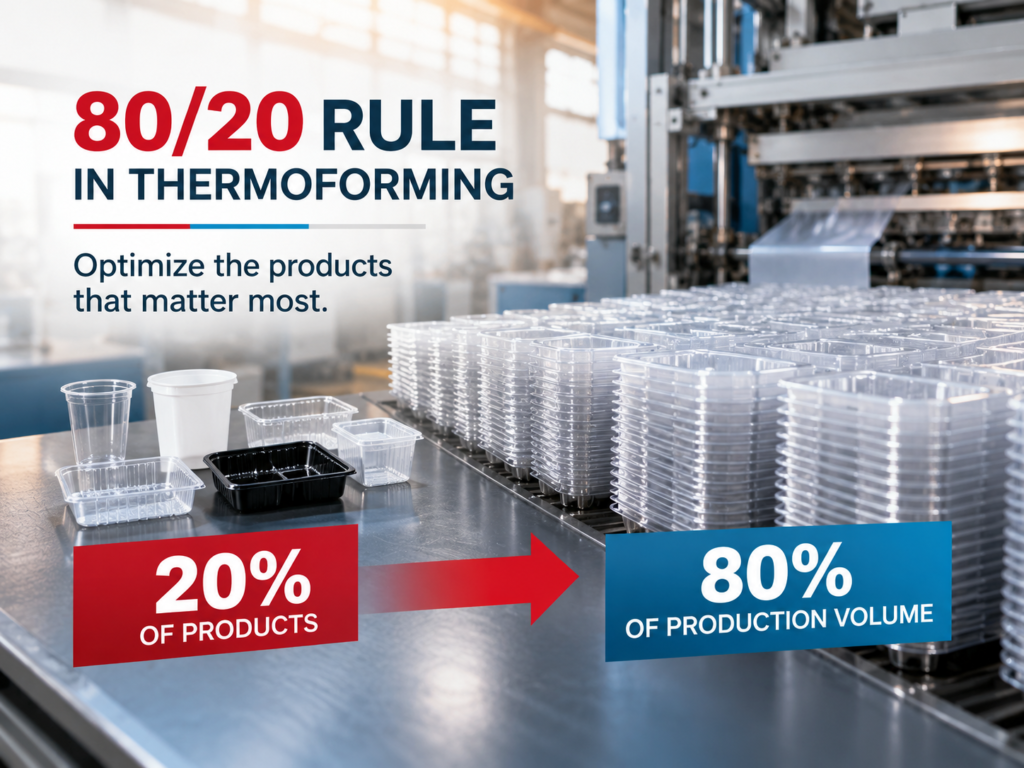
Not every thermoformed product deserves the same optimization priority. In many factories, a relatively small number of high-volume articles accounts for a large share of total production. Improving those products first can deliver a much greater business impact than spreading your efforts evenly across the entire portfolio.
What the 80/20 Rule Means for Thermoforming
The Pareto Principle, often called the 80/20 rule, describes a common pattern: a minority of causes accounts for a majority of results. In production, this may mean that approximately 20% of product references generate around 80% of total output.
The exact ratio varies from factory to factory. Some plants may have a 70/30 distribution, others a much more concentrated product mix. The important point is not the precise percentage. It is recognizing that the production volume is rarely distributed equally across all products.
Why High-Volume Products Deserve Attention First
Consider two thermoformed products. One runs almost every day. The other is produced only a few times a year. Both may have opportunities to improve cycle time, scrap rate and process stability. But the same percentage improvement will not necessarily create the same annual savings.
On a high-volume article, even a small reduction in cycle time or scrap can be repeated thousands of times per shift and across many production days. That is where optimization becomes financially powerful.
- More saleable parts: A higher validated cycle rate increases capacity during existing production hours.
- Lower scrap: Small improvements in good-part yield accumulate over large annual volumes.
- More stable quality: Fewer adjustments and fewer interruptions help maintain reliable output.
- Less pressure on overtime: Additional capacity during regular shifts may reduce the need for weekend or holiday production, if the demand and schedule allow it.
- Better use of engineering time: The same optimization effort can influence a larger share of the factory’s annual output.
A Simple Example: Two Extra Cycles per Minute
Imagine a high-volume cup running on a 24-cavity tool. The validated process currently operates at 20 cycles per minute. Through better cooling, forming conditions, tooling interaction and process settings, the team reaches a stable 22 cycles per minute without compromising product quality.
| Production parameter | Before | After optimization |
|---|---|---|
| Cycle rate | 20 cpm | 22 cpm |
| Cavities | 24 | 24 |
| Theoretical parts per hour | 28,800 | 31,680 |
| Theoretical parts in 16 hours | 460,800 | 506,880 |
| Additional parts in 16 hours | — | 46,080 (+10%) |
Illustrative example only. Calculations assume continuous operation, 100% availability and 100% good-part yield. Actual output and savings depend on downtime, scrap, staffing, material use and demand.
Now imagine that this is one of the plant’s most frequently produced articles. The improvement can be repeated across many production days. On a rarely produced item, the same technical success may generate much less annual benefit.
How I Would Prioritize an Optimization Project
1. Identify the real top-volume products
Start with actual production data from the last 6 to 12 months. Rank products by annual good-part volume, machine hours or production demand. Sales revenue alone can be misleading: an expensive low-volume article is not necessarily one of the factory’s biggest capacity drivers.
2. Look for the largest performance gaps
Within the high-volume group, compare actual performance against validated targets. Check cycle rate, scrap, downtime, product quality, tool-cavity consistency and downstream performance. A high-volume article already running close to its technical limit may offer less potential than one with a clear, correctable bottleneck.
3. Investigate the complete process
Thermoforming productivity is never just a machine-speed setting. It depends on the interaction between sheet quality, heating, forming air, vacuum, plug assist, cooling, tooling, punching, stacking and infrastructure.
Before increasing speed, identify which part of the process limits stable, repeatable production. The target is not the highest number displayed on the control panel. It is the highest sustainable output of good products.
4. Validate the improvement and train the team
Once a better process has been developed, document the operating window, quality requirements and validated cycle-rate target. Train operators and technicians to understand why the settings work and which warning signs require investigation.
5. Transfer the knowledge to the remaining portfolio
This is where the second benefit begins. Improvements made on the highest-volume products often reveal recurring weaknesses in cooling-water distribution, air-pressure build-up, tooling maintenance, extrusion quality or operator practices. These lessons can then be applied to other products and machines.
Not Every Product Should Be Treated Equally
A practical prioritization model should consider more than volume alone:
| Factor | Question to ask |
|---|---|
| Annual production volume | How often is this article produced, and how many good parts are required? |
| Cycle-time potential | Is there a measurable gap between actual and technically achievable output? |
| Scrap and quality losses | How much material and capacity are lost to defects or unstable quality? |
| Machine utilization | Is this product running on a bottleneck machine or during expensive overtime? |
| Repeatability | Can the improvement be sustained across shifts and operators? |
| Transfer potential | Will the solution help other tools, products or production lines? |
There are exceptions. A low-volume product with a serious quality risk, customer complaint or unusually high scrap cost may deserve immediate attention. The Pareto Principle helps set priorities; it does not replace sound technical and business judgment.
The Bigger Benefit: Building a Stronger Production Team
When I work with operators and technicians on a real production bottleneck, the goal is not simply to leave behind a faster machine. I want the team to understand the process: why the cooling matters, what determines material distribution, how forming-air dynamics affect quality and which parameters define a stable production window.
That knowledge does not stay with one product. The same troubleshooting methods can be applied to the next tool and the next production line. The original optimization creates immediate capacity; the training creates the potential for lasting improvement across the portfolio.
Start Where the Impact Is Greatest
Before investing time in optimizing every product, take a look at your production data. Which articles account for most of your annual volume? Which of those have the largest gap between actual and validated performance? And does your team understand the technical reasons behind that gap?
At Dobringer Thermoforming Consulting, I help manufacturers identify these bottlenecks, optimize their high-impact products and train their teams directly on the production line.
Learn more about on-site thermoforming training or contact DTC to discuss your production priorities.