
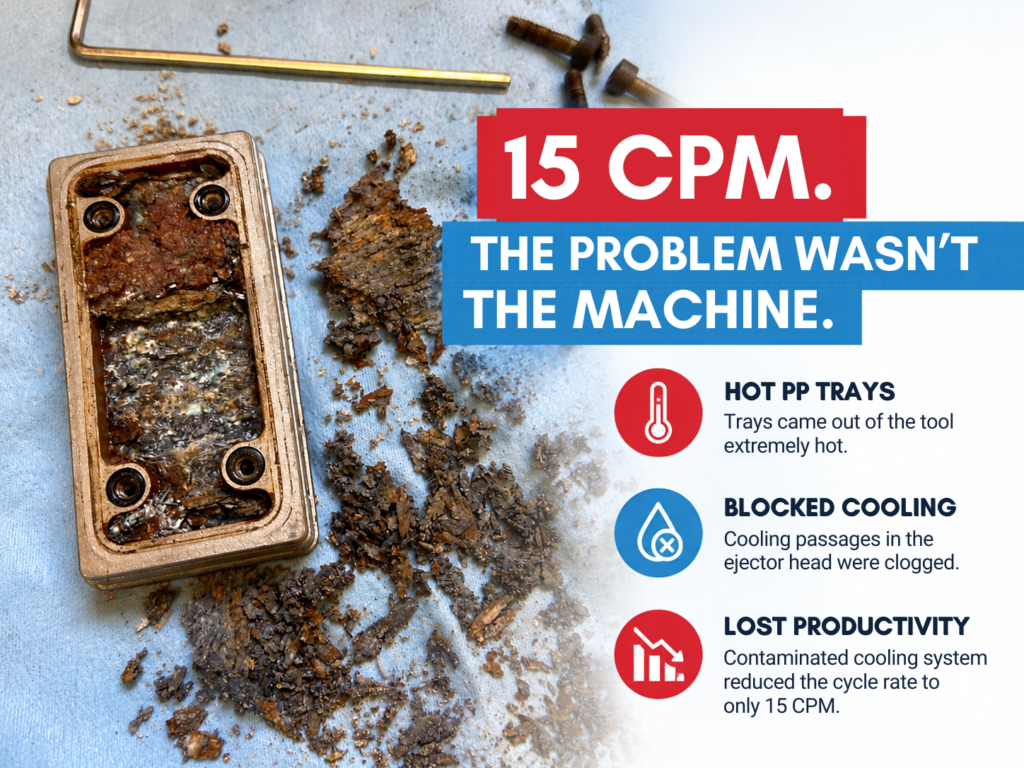
A thermoforming machine was producing polypropylene trays at approximately 15 cycles per minute. The trays were leaving the tool unusually hot. What looked like a productivity problem turned out to be a warning sign of a much wider cooling-system issue.
When Low Productivity Becomes the New Normal
A customer contacted me because the output of a thermoforming line was too low. The product was a polypropylene (PP) tray, and the machine was running at around 15 cycles per minute.
One observation stood out immediately: the trays were still extremely hot after leaving the forming tool.
In my practical assessments, the temperature at the bottom of a cup or tray is an important early indicator. If the bottom remains unusually hot after demolding, I investigate whether the cooling process is removing enough heat. For a reliable assessment, surface temperature should be checked with an appropriate, non-contact measuring instrument rather than by touching hot parts.
The Root Cause: Contamination Inside the Ejector Head
During the investigation, we found accumulated contamination inside the ejector head. Over years of operation, deposits had restricted the cooling-water passages, preventing water from flowing as intended.
And the issue was not limited to a single ejector component. The cooling-water system was contaminated more broadly. In this case, the machines, tools and associated cooling circuits required thorough cleaning.
Why Bottom Cooling Is So Important
The bottom of a thermoformed cup or tray can become a limiting area for cycle time. Its geometry, local wall thickness, contact with the tool and cooling conditions all affect how quickly the part can be released while maintaining the required shape and dimensional stability.
If cooling performance deteriorates, the production team may compensate by increasing cooling time or reducing the cycle rate. That can restore acceptable product quality in the short term while concealing the underlying restriction.
- Restricted water flow: Deposits or blocked passages reduce the cooling capacity available at critical tool areas.
- Unbalanced cooling: Some cavities or components may cool differently, creating inconsistent product temperatures and dimensions.
- Longer cycle time: Operators may slow the machine to prevent deformation, stacking issues or handling problems.
- Downstream effects: Hot products may create difficulties during stacking, conveying, packing or further processing.
Water temperature alone does not confirm adequate cooling. Flow rate, pressure loss, circuit distribution and heat removal must also be evaluated.
The Warning Signs Were Already There
What concerned me most was not simply the contamination. It was how many warning signs had gone unnoticed.
Operators, maintenance personnel and those responsible for utilities all interact with different parts of the production system. Yet a line can gradually lose performance when nobody connects a slower cycle rate, hot products and declining cooling efficiency into one diagnosis.
This is not about blaming individuals. It is about establishing measurable standards and clear responsibility for investigating deviations.
Why I Believe in Validated Cycle-Rate Targets
I am a strong supporter of documented cycle-rate targets for each product, tool and production setup. Those targets should be established through testing at a stable quality level, with the actual machine, tooling, material and infrastructure.
A target is not a number chosen simply because a machine brochure promises it. It is a validated production benchmark that can be repeated under defined operating conditions.
What a Meaningful Production Standard Should Include
| Parameter | Why it matters |
|---|---|
| Validated cycles per minute | Shows whether the line is still achieving its established stable operating rate. |
| Product temperature after demolding | Helps identify changes in cooling performance and handling conditions. |
| Cooling-water supply and return temperatures | Provides context for the heat-removal process; temperature readings alone are not sufficient. |
| Water flow and pressure | Helps reveal restrictions, circuit imbalance or insufficient supply. |
| Good-part yield and dimensional stability | Confirms that increased speed does not come at the expense of product quality. |
| Stacking and downstream performance | Checks that the complete line can sustain the validated output. |
How Much Capacity Can a Few Lost Cycles Cost?
Consider an illustrative 20-cavity tool running for 16 hours. The calculation below assumes continuous running time and does not include downtime or scrap.
| Cycle rate | Theoretical parts in 16 hours | Difference vs. 15 cpm |
|---|---|---|
| 15 cpm | 288,000 | — |
| 17 cpm | 326,400 | +38,400 |
| 18 cpm | 345,600 | +57,600 |
Illustrative calculation: cycles/min × 20 cavities × 60 minutes × 16 hours. These are not measured results from the customer case; actual saleable output depends on availability and good-part yield.
Even a difference of two or three cycles per minute can have a significant effect on daily output. But the goal is not to increase the speed setting blindly. The goal is to restore a stable process by removing the cause of the limitation.
A Practical Cooling-System Investigation
- Compare actual performance with the validated benchmark. Identify when the cycle rate changed and whether quality or product temperature changed at the same time.
- Measure product temperature consistently. Use suitable instruments and a repeatable measurement location and timing after demolding.
- Check water supply, return and flow. Compare actual readings with the requirements of the tool and cooling circuits.
- Inspect critical cooling passages. Include ejector heads, manifolds, tool circuits, filters and other areas susceptible to deposits.
- Restore and verify cooling performance. Cleaning or corrective maintenance must follow appropriate procedures, with the equipment safely isolated and the circuits checked afterward.
- Validate the cycle rate again. Confirm consistent product quality, temperatures and downstream performance at the restored operating conditions.
The Real Lesson: Do Not Normalize Lost Productivity
In this case, the issue had developed over time. A contaminated cooling system had become part of everyday production, while the machine continued to run below its potential.
The key lesson is straightforward: a reduction in cycle rate to preserve product quality should trigger structured troubleshooting, not silent acceptance.
Cooling performance is not only a maintenance topic. It is a productivity topic, a quality topic and ultimately a business topic.
Fresh Eyes Can Reveal What Routine Has Hidden
At Dobringer Thermoforming Consulting, I help production teams investigate the actual bottlenecks behind lost output. I work with operators, maintenance personnel and management to understand the interaction between tooling, cooling, forming conditions and production standards.
If your thermoforming machine has gradually become slower—or your products are leaving the tool hotter than they should—let’s find out why.
Learn more about on-site thermoforming training or contact DTC to discuss your production bottlenecks.