
Industry News & Technical Perspective · DTC Insights
A faster thermoforming machine is an important development. But the real measure of performance is not the maximum cycle rate—it is the number of good products a complete production line delivers consistently.
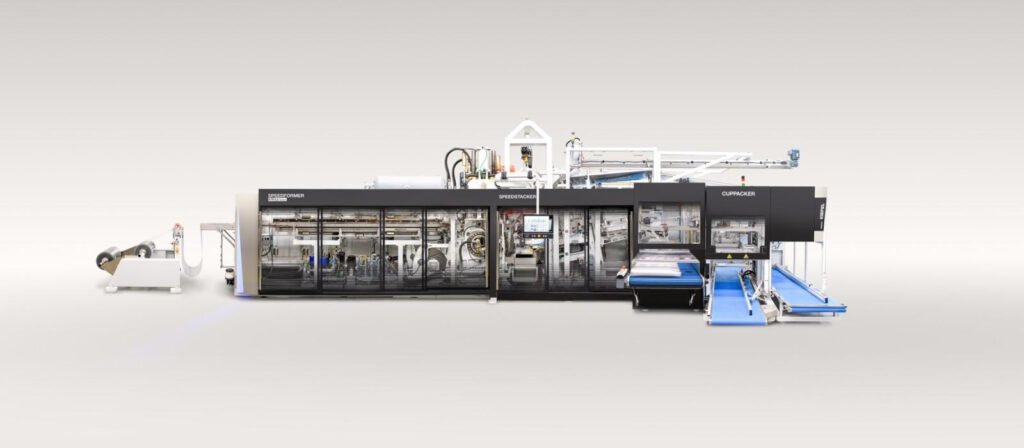
Kiefel’s SPEEDFORMER KTR 6.2 Speed provides an opportunity to examine that distinction. The machine was introduced before 2026, with additional developments highlighted around K 2025. The manufacturer’s focus on forming air, cooling, sheet handling and downstream automation addresses challenges familiar to many thermoforming producers.
Does a faster thermoforming machine automatically mean higher saleable output? Not if the tool, cooling circuit, forming-air supply or downstream handling becomes the limiting factor.
Kiefel KTR 6.2 Speed: Machine Technology in Context
The KTR series is designed for high-volume thermoforming applications, including cups and other packaging products. Kiefel highlights productivity-related developments such as SpeedGuard for sheet guidance and ProSpacing for product transfer.
Published machine specifications and promotional performance figures must be read in their application context. The achievable cycle rate depends on the specific machine configuration, product geometry, material, tooling and downstream equipment. For authoritative model data, consult the official Kiefel SPEEDFORMER KTR product overview.
Machine capability is only one part of the equation. The production result is determined by the interaction between machine, tool, material and process.
1. Forming Air: Pressure Build-Up Matters
Forming-air performance is not defined by the pressure setpoint alone. What matters is how quickly sufficient pressure reaches the forming cavities at the correct point in the machine sequence.
Common restrictions include:
- Insufficient valve flow capacity
- Undersized air lines or restrictive connections
- Limited air storage capacity
- Pressure losses between the supply system and tool
- Restricted internal air passages
These restrictions can influence forming accuracy, material distribution and the time required to complete the forming step.
Measure the dynamic pressure curve as close to the tool as practical. A nominal pressure reading does not show how fast pressure builds during a short forming cycle.
2. Cooling: A Frequent Cycle-Time Limitation
Cooling is often one of the most important constraints in high-output thermoforming. The formed part needs sufficient dimensional stability before punching, demolding and handling.
At higher production speeds, insufficient or uneven cooling can contribute to:
- Unstable sealing rims
- Bottom deformation or warpage
- Dimensional variation
- Handling problems after demolding
- Higher scrap rates
Cooling-water temperature is only one variable. Flow rate, pressure drop, channel design, tool surface temperature and heat transfer must be considered together.
Before shortening cooling time, establish whether the cooling system can remove heat quickly and uniformly. A colder chiller setting alone may not solve a flow restriction inside the tool.
3. Punching and the Machine–Tool Interface
Higher production speeds also increase the importance of reliable punching. Tool alignment, cutting geometry, clearance, temperature and mechanical stability all influence repeatability.
Even when the machine has sufficient nominal punching force, the overall process may still be limited by tooling condition or the interaction between the machine and tool.
4. Sheet Handling and Downstream Automation
Technologies such as Kiefel’s SpeedGuard and ProSpacing demonstrate why production performance must be evaluated beyond the forming station.
If the sheet transport, part removal, stacking or packing system cannot keep up, the theoretical forming capacity will not become saleable output.
The bottleneck—not the fastest station—determines the capacity of the complete production line.
5. What Does Three Additional Cycles per Minute Mean?
Consider a simplified production example with 40 cavities and an increase from 30 to 33 cycles per minute.
| Parameter | Before | After |
|---|---|---|
| Production speed | 30 cycles/min | 33 cycles/min |
| Cavities | 40 | 40 |
| Theoretical output/hour | 72,000 | 79,200 |
| Theoretical output/24 hours | 1,728,000 | 1,900,800 |
Important: This calculation assumes continuous operation, full cavity utilization and no rejects. Actual saleable output depends on availability, quality and downstream performance. These figures are an illustrative process calculation, not a Kiefel performance test.
To explore the economic effect of cycle-time improvements, see the DTC website and its Savings & ROI Calculator.
6. What Existing Thermoforming Lines Can Learn
New machine developments can also provide useful questions for operators of existing equipment:
- How quickly does forming pressure reach the cavities?
- Is cooling capacity limiting the cycle?
- Does the tool support the target cycle rate?
- Is product handling creating unnecessary waiting time?
- Can material distribution be improved without increasing rejects?
In some cases, optimizing the existing machine–tool–process combination can deliver meaningful improvements. In others, investment in new equipment is the right choice. The decision should be based on measured bottlenecks and economic return.
Conclusion: Higher Output Requires a Complete Process View
The Kiefel SPEEDFORMER KTR 6.2 Speed illustrates an important direction in modern thermoforming: productivity depends on coordinated improvements across forming, cooling, tooling, transport and automation.
Manufacturer specifications describe machine capability. Good products per hour describe production performance.
Dobringer Thermoforming Consulting focuses on identifying the real bottlenecks in thermoforming production and translating technical improvements into measurable business results.
Sources & further reading
Editorial note: This independent technical commentary is based on publicly available manufacturer information and general thermoforming engineering principles. DTC has not independently tested the KTR 6.2 Speed. Manufacturer performance claims should be evaluated for each specific application.