
Process Optimization · Productivity · Labor Cost
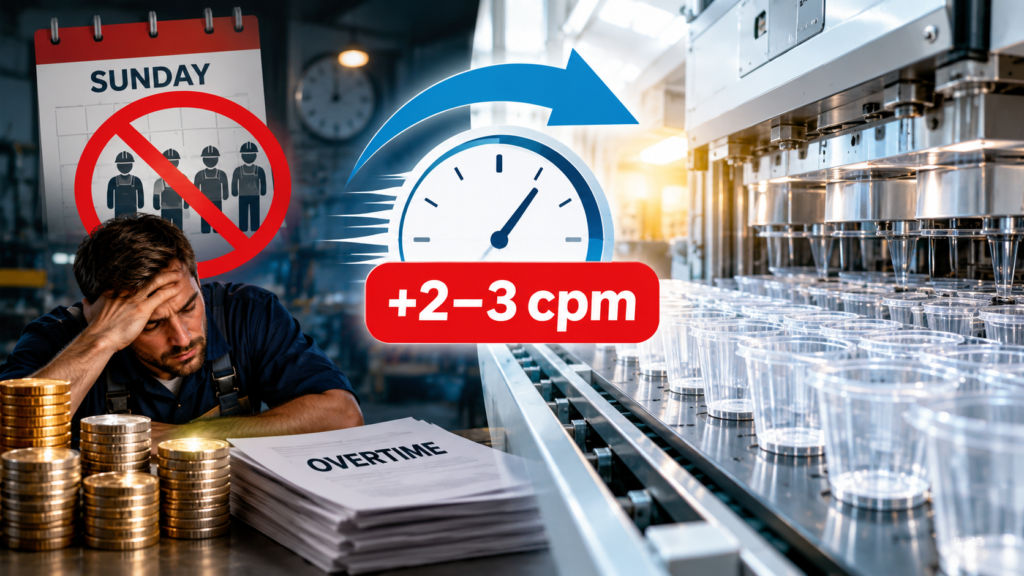
What if your thermoforming plant could meet its weekly production target without running on Sunday or a public holiday? In some operations, the answer is not another machine or another shift. It is just two or three additional cycles per minute on the equipment you already own.
Weekend and holiday production can be expensive. Depending on local labor agreements, employees may receive premium pay, additional time off, or both. Supervisors, quality personnel, maintenance support, utilities and logistics can add to the total cost of opening a plant outside normal operating hours.
Yet many manufacturers treat these shifts as unavoidable. Before scheduling another Sunday, there is a question worth asking: Could a modest improvement in weekday cycle time produce the same volume?
Two Extra Cycles Can Change the Weekly Production Plan
Consider a thermoforming line producing a product with 24 cavities. It currently runs at 20 cycles per minute (cpm), for 16 scheduled hours per weekday over five days. For clarity, assume 100% availability and saleable yield in this first illustration.
| Production parameter | Current | Improved |
|---|---|---|
| Machine speed | 20 cpm | 22 cpm |
| Cavities per cycle | 24 | 24 |
| Scheduled weekday hours | 80 h | 80 h |
| Theoretical parts per hour | 28,800 | 31,680 |
| Theoretical weekday output | 2,304,000 | 2,534,400 |
| Additional weekday output | — | 230,400 parts |
That extra weekday output is equal to eight hours of production at the original speed. In this simplified example, a single eight-hour weekend shift could become unnecessary—provided the line can maintain the improved rate and produce the required saleable quantity.
What About Three Extra Cycles per Minute?
At 23 cpm, the same 24-cavity machine produces 33,120 theoretical parts per hour. Across 80 scheduled weekday hours, that is 2,649,600 parts—345,600 more parts per week than at 20 cpm. That represents 12 hours of production at the original speed.
The lesson is not that every plant can eliminate weekend work with a 2–3 cpm increase. It is that small, sustainable cycle-time improvements can create enough capacity to reconsider the shift schedule.
Why Sunday and Public Holiday Labor Costs Matter
The financial benefit depends on the country, collective bargaining agreement, employment contracts and staffing model. Sunday or public holiday work may trigger wage premiums or compensatory time, but these arrangements vary significantly by jurisdiction.
For a useful business case, compare the avoidable cost of the weekend shift with the incremental cost of producing the same volume during normal hours. Consider:
- Direct labor and applicable weekend or holiday premiums
- Supervision, quality assurance, material handling and maintenance coverage
- Start-up, shutdown, cleaning and material changeover losses
- Utilities and other operating costs that would genuinely be avoided
- Any weekday costs caused by higher speed, such as extra scrap or maintenance
Do not count fixed salaries, depreciation or other costs as savings unless they actually change. And do not assume all weekend wages disappear if employees must be reassigned or compensated under local rules.
Illustrative Labor Cost Calculation
Suppose an eight-hour Sunday shift requires six operators and one supervisor. Assume an illustrative fully loaded Sunday labor cost of €45 per operator-hour and €60 per supervisor-hour. These are example assumptions, not typical or legally prescribed rates.
| Cost component | Calculation | Illustrative cost |
|---|---|---|
| Operators | 6 × 8 h × €45 | €2,160 |
| Supervisor | 1 × 8 h × €60 | €480 |
| Sunday labor cost | €2,640 | |
| Annual total at 40 avoidable Sundays | 40 × €2,640 | €105,600 |
That €105,600 is the illustrative gross Sunday labor cost potentially avoidable, not an automatic net saving. The actual net benefit must deduct any replacement weekday labor, higher-speed operating costs, and other expenses that remain.
Calculate Your Thermoforming Productivity Potential
What would two or three additional cycles per minute mean for your production? Use our free calculator to estimate additional capacity and potential financial benefits based on your own production data.
Open the Savings & ROI Calculator →
Note: The calculator does not separately calculate Sunday or public holiday wage premiums. Estimate avoidable weekend labor costs using your own staffing and employment assumptions.
The Real Challenge: Finding Two or Three Sustainable Cycles
On many thermoforming lines, machine speed is not limited by the nominal machine specification. It is limited by one or more process bottlenecks:
- Heating: inconsistent sheet temperature or insufficient heating capacity at higher throughput
- Forming air: slow pressure build-up, restrictive valves or insufficient air delivery
- Cooling: limited water flow, poor channel design or insufficient heat removal
- Tooling: venting restrictions, unfavorable material distribution or unstable ejection
- Machine–tool interface: sequence timing, downholder movement, plug-assist timing or vacuum response
- Downstream equipment: punching, stacking, conveying, printing or packing that cannot keep pace
Increasing the speed setting without addressing the actual constraint can create more scrap, unstable dimensions, poor stacking and customer complaints. That is not a productivity improvement.
Measure Saleable Output, Not Just Cycles per Minute
A machine that runs faster but produces more rejected parts may deliver little or no financial benefit. Evaluate output using a simple, practical measure:
For example, the theoretical gain from 20 to 22 cpm is 10%. But if higher speed reduces availability or yield, the actual gain is smaller. Validate the improvement over representative production runs, not only a short trial.
A Practical Five-Step Approach
- Establish the baseline. Record actual cycles, uptime, scrap, product weight and weekly saleable output.
- Identify the limiting process. Measure heating, forming air, vacuum, cooling and downstream cycle times before adjusting settings.
- Implement targeted improvements. Correct the verified constraint rather than changing multiple parameters at once.
- Validate stable output. Confirm product quality and reliability across complete shifts and representative material batches.
- Recalculate the shift plan. Determine whether the verified weekday capacity can replace some or all Sunday or holiday production.
More Productivity Can Be Worth More Than Another Shift
For plant managers, production efficiency is not simply about making a machine run faster. It is about meeting customer demand with the lowest sustainable total cost—without compromising quality, safety or equipment reliability.
Before accepting expensive weekend production as the new normal, quantify the gap between required weekly output and what your existing lines could produce with two or three additional stable cycles per minute.
Sometimes the most valuable production shift is the one you no longer need to run.
Independent technical perspective: Dobringer Thermoforming Consulting. Illustrations are simplified and should be adapted to actual production data, local employment rules and site-specific costs.