
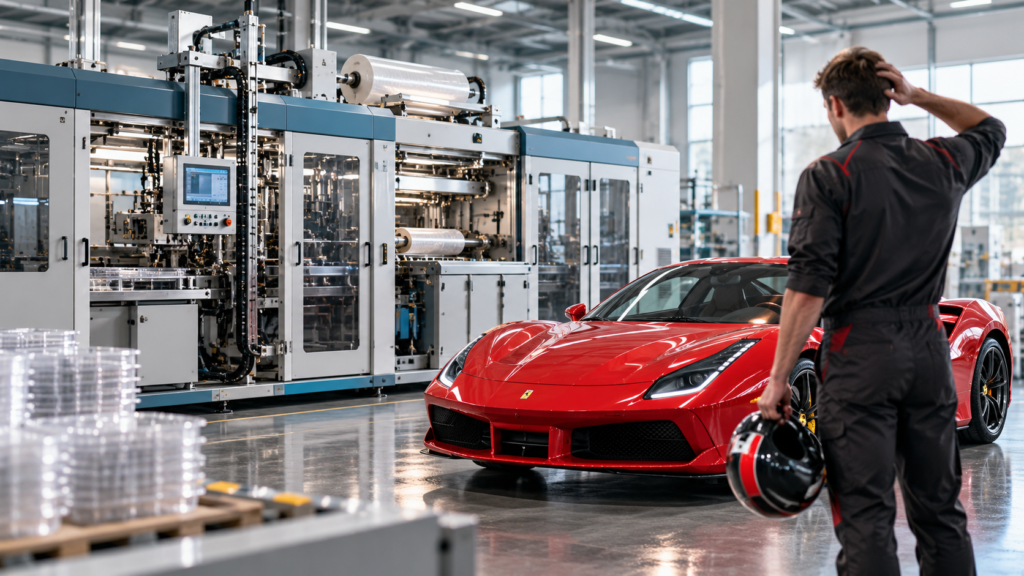
Buying a high-performance thermoforming machine does not automatically create a high-performance production line. The real question is whether the tooling, infrastructure, maintenance capability and people are ready to unlock what the machine can deliver.
The Investment Decision: Lower Purchase Price or Higher Potential Output?
When manufacturers plan a new thermoforming project, they often face a difficult choice. Should they invest in a lower-cost machine with a more modest output target, or select a sophisticated high-end machine designed for maximum speed, precision and productivity?
Both choices can be commercially sound. The mistake is to compare machines only by purchase price, maximum cycles per minute or a supplier’s headline performance figures. What matters is the stable output of saleable products under real production conditions—and the total cost required to achieve it.
A High-End Machine Is Only One Part of a High-End Production System
I regularly see the same underlying challenge: a manufacturer invests in advanced machinery, but the supporting production system is not developed to the same level. The machine may be capable of exceptional performance, yet the line runs far below its potential.
Why? Because the machine cannot compensate indefinitely for limitations elsewhere.
| System element | What limits real performance? |
|---|---|
| Tooling | Cooling efficiency, cavity balance, forming air distribution, venting, ejection, trimming and product consistency. |
| Infrastructure | Insufficient cooling-water flow or temperature control, compressed-air capacity, vacuum performance, power supply and material handling. |
| Maintenance | Unstable machine condition, delayed preventive maintenance, inadequate troubleshooting and inconsistent calibration. |
| People and process knowledge | Operators who know the settings but not the interactions between machine, tool, material and process. |
| Downstream equipment | Stacking, conveying, inspection, printing, packing or other steps that cannot keep up with the forming line. |
Install an average tool on an excellent machine, supply it with inadequate utilities and run it with a team that has not been trained for high-speed production, and the result may be surprisingly similar to that of a less expensive system.
That does not make the high-end machine a poor investment. It means the project has not yet created the conditions needed to realize the investment.
The Ferrari Comparison: Horsepower Is Not the Same as Performance
Imagine giving a Ferrari to someone who has only just started learning to drive. The car has enormous potential, but the driver may struggle with the basics and will certainly not be ready to explore its performance limits safely.
A professional racing team needs much more than a powerful car: skilled drivers, engineers, suitable tires, correct setup, maintenance and a well-prepared track. Every element contributes to the result.
Thermoforming performance is not achieved by pushing the speed setting higher and hoping for the best. It requires a clear understanding of how each part of the process behaves as cycle time decreases.
What Happens When You Push the Cycle Time?
Increasing speed changes the available time for heating, forming, cooling, venting, trimming and part handling. A process that appears stable at a moderate cycle rate may become unreliable just a few cycles per minute faster.
- Is forming air building up quickly enough at the cavities?
- Can the tool remove sufficient heat at the new cycle time?
- Is material distribution still consistent across all cavities?
- Does the ejection and stacking system remain stable?
- Can operators identify the real bottleneck rather than compensating with unrelated parameter changes?
These are engineering questions—not simply machine-setting questions.
A Simple Output Example
Consider a 24-cavity tool operating for 16 scheduled production hours per day. The comparison below is illustrative, not a claim about any particular machine.
| Scenario | Cycles/min | Good-part yield | Saleable parts/day* |
|---|---|---|---|
| High-end line, underutilized | 20 | 95% | 437,760 |
| High-end line, optimized | 24 | 97% | 536,371 |
*Calculation: cycles/min × 24 cavities × 60 minutes × 16 hours × good-part yield. Assumes all scheduled hours are running hours, with no additional downtime; figures rounded to whole parts.
In this example, improving the operating speed from 20 to 24 cycles per minute while raising good-part yield from 95% to 97% produces approximately 98,600 more saleable parts per day—about 22.5% more than the underutilized scenario.
The potential is substantial, but the additional output only creates value if quality is maintained, downstream operations can handle it and customer demand exists.
Five Questions to Ask Before Approving a High-Performance Line
- Tooling: Is the tool designed and validated for the target output, not merely for the product geometry?
- Utilities: Have cooling, compressed air, vacuum and material supply been sized for actual peak demand?
- People: Can the production team explain the process and troubleshoot the interactions between machine, tool and material?
- Maintenance: Is there a plan, with the right skills and spare parts, to sustain high performance over time?
- Business case: Is the investment evaluated on realistic good-part output, operating costs, training and ramp-up—not only theoretical maximum speed?
Training, process validation, tooling improvements and infrastructure upgrades belong in the investment calculation from the beginning—not as unexpected costs after commissioning.
Training Should Happen on the Actual Production Line
In my experience, the most effective training starts with real bottlenecks on the customer’s own equipment. Operators and technicians learn far more when they can see how machine settings, tooling, material and product quality interact in their everyday production environment.
Instead of teaching which buttons to press, I focus on why the process responds the way it does. We investigate the limits together: forming air, vacuum, heating, cooling, sequencing, material distribution and downstream handling.
The objective is not to run every machine at its theoretical maximum under all circumstances. It is to find the highest stable, repeatable and economically sensible output for the product and production system.
My Role: Turning Machine Potential into Real Production Results
At Dobringer Thermoforming Consulting, I work independently alongside machine manufacturers, toolmakers and production teams. I help identify where performance is being lost and train the people who need to sustain the improvements.
I help you put the horsepower onto the road. If your high-end thermoforming line is not delivering the output you expected, the first step is to understand what is really holding it back.
Learn more about on-site thermoforming training or contact DTC to discuss your production bottlenecks.