
Process Optimization · Thermoforming Tooling · Business Impact
What if you could fit more thermoformed cups or containers into the same shipping box—without changing the box, the material or the product’s intended function? The answer may lie in a detail that is often underestimated: the stacking rim.
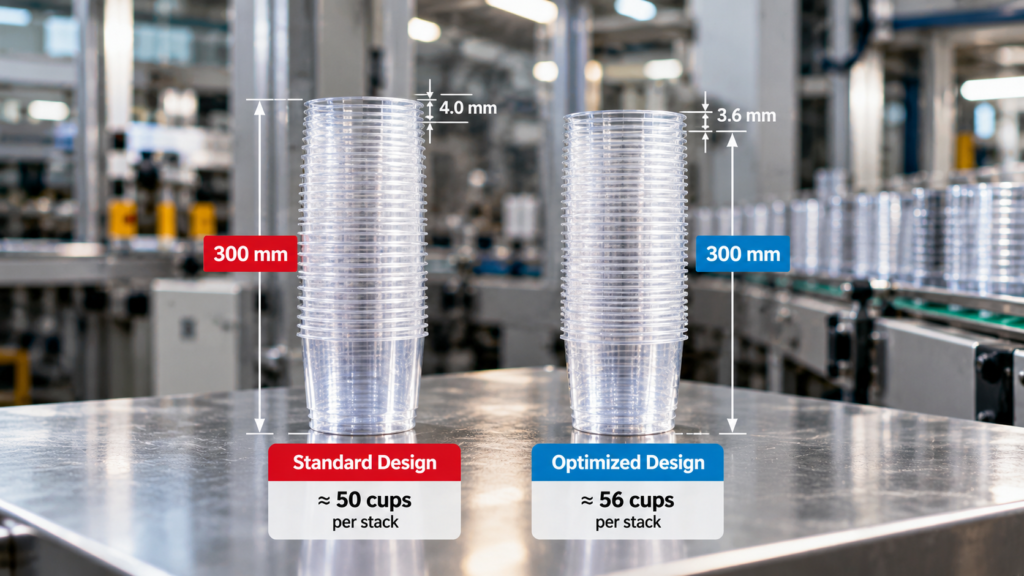
In thermoforming, stacking rim geometry and consistent forming quality influence how closely products nest, how many units fit into a stack and how reliably those stacks run through downstream equipment. Even a small reduction in stacking pitch can have a measurable impact on packaging, handling, transport and labor.
1. The stacking rim is more than a design detail
A stacking rim, stacking shoulder or stacking feature controls how nested products rest on each other. Its geometry helps determine the stacking pitch—the additional height contributed by each product placed into a stack.
When the stacking pitch is unnecessarily large, every additional product adds avoidable height. Across a full stack or shipping box, fractions of a millimeter can become valuable space.
- More units per stack: A lower, controlled stacking pitch can increase the number of products on a rod or in a sleeve.
- More units per shipping box: Depending on box geometry and packing configuration, the same outer packaging may hold more products.
- Less packaging per product: More products per box can reduce the number of cartons, liners, labels and handling movements needed for a given order quantity.
- Potential logistics savings: Fewer boxes or pallets for the same quantity may reduce storage requirements and transport demand.
2. A small change in stacking pitch can make a big difference
Consider an illustrative thermoformed cup with an overall height of 80 mm. A shipping box offers 600 mm of usable stacking height. Assume that nesting is stable and that all products have a consistent stacking pitch.
| Parameter | Before optimization | After optimization |
|---|---|---|
| Product height (first cup) | 80 mm | 80 mm |
| Stacking pitch per additional cup | 4.0 mm | 3.6 mm |
| Usable box height | 600 mm | 600 mm |
| Maximum theoretical cups per stack | 131 | 145 |
| Additional cups per stack | — | 14 (+10.7%) |
Illustrative calculation: N = floor((usable box height − first product height) / stacking pitch) + 1. Values assume a fixed first-product height and no extra clearance requirement. Real packing limits, rim tolerances, deformation, box dimensions, product friction and stacking orientation must be verified in trials.
If the packing arrangement allows the same number of stacks per box, a higher cup count per stack translates into more cups per box. However, the final result must be confirmed with actual products and packaging trials.
3. Better thermoforming creates new design opportunities
Tool design defines the intended geometry—but the thermoforming process must reproduce it accurately, cavity after cavity and cycle after cycle.
When the stacking rim is not formed consistently, designers may need to allow extra clearance to prevent jamming or difficult separation. A more stable forming process can make tighter, more efficient stacking geometries practical. This can create opportunities to redesign the rim and reduce stacking pitch while maintaining reliable handling.
What influences stacking-rim accuracy?
- Material temperature and heating uniformity: Uneven sheet temperature changes local stretch and detail reproduction.
- Forming air and vacuum dynamics: Pressure build-up, venting and the sequence determine how precisely the sheet reaches the intended contour.
- Tool geometry and air evacuation: Small details around the stacking rim require appropriate venting and a tool design suited to the material and forming method.
- Cooling performance: Uneven or insufficient cooling can cause dimensional changes after demolding.
- Material distribution and shrinkage: Local wall thickness, polymer behavior and process temperature affect the final geometry.
- Process repeatability: A good result in one cavity is not enough if other cavities or production cycles differ.
4. The problem I see repeatedly: different stack heights from the same tool
In my experience working with thermoforming production lines, many manufacturers struggle to achieve the same stack height across every cavity of a multi-cavity tool.
One cavity may produce cups that nest closely. Another may produce a slightly different stacking rim, creating a taller or less stable stack—even though the nominal product design is identical.
This is more than a quality issue. It can prevent companies from reducing stacking pitch, increasing packing density or running downstream equipment reliably.
How to identify the variation
- Separate products by cavity and label the samples clearly.
- Build stacks using the same number of products from each cavity.
- Measure total stack height under a defined, repeatable measurement method.
- Compare cavity-to-cavity variation and repeat the test across multiple production cycles.
- Investigate forming, venting, cooling and material conditions before changing the tool geometry.
For meaningful comparisons, also define the time after production, ambient conditions and any compression force applied during measurement. Freshly formed products may behave differently from conditioned products.
5. Why consistent stack height matters after thermoforming
Dimensional consistency does not stop being important when products leave the thermoforming machine. It often becomes even more critical during decoration, filling and packing.
Cup feeding and screw separation
In cup printing and other downstream processes, screw feeders and separation systems rely on predictable product geometry and stack behavior. If the stacking rim or nesting pitch varies, cups may feed inconsistently, jam or separate unreliably.
Denesting and automated handling
Denesting equipment must release products one by one. Excessive friction, inconsistent rim geometry or unstable stack height can increase interruptions and manual intervention.
Packaging and transport
Uniform stacks are easier to count, handle and pack consistently. They can also make it easier to use available box space efficiently—provided that the optimized stack remains stable and products do not deform during transport.
6. Measure the economic benefit—not just the millimeters
A stacking-rim optimization project should be evaluated using the actual number of products shipped, not only the dimensional improvement measured at the tool.
- Products per box: Compare validated packing quantities before and after optimization.
- Boxes per order: Calculate how many cartons are required for the same customer quantity.
- Packaging cost per 1,000 products: Include boxes, liners, labels and other packaging components.
- Handling and logistics: Consider pallet utilization, warehouse movements and transport constraints.
- Downstream efficiency: Track jams, denesting failures, feeder stops and scrap before and after process stabilization.
For example, increasing validated capacity from 1,000 to 1,100 products per box would reduce the number of boxes needed for 110,000 products from 110 to 100—a reduction of approximately 9.1% in box count. The actual financial saving depends on the packaging and logistics cost structure.
7. Where I would start on your production line
Before investing in new tooling or redesigning a product, I would first ask a simple question:
Do all cavities of your existing thermoforming tool produce the same stacking height?
If the answer is no, there may already be an opportunity to improve the process. Stable forming, accurate stacking rims and consistent cavity results provide the foundation for a more efficient product design and reliable downstream handling.
Are you seeing different stack heights from different cavities? If so, contact Dobringer Thermoforming Consulting. I help manufacturers identify the process conditions behind dimensional variation and improve the interaction between machine, tool, material and downstream production.
Fresh Eyes. Fast Impact.