
Industry News & Technical Perspective | DTC Insights
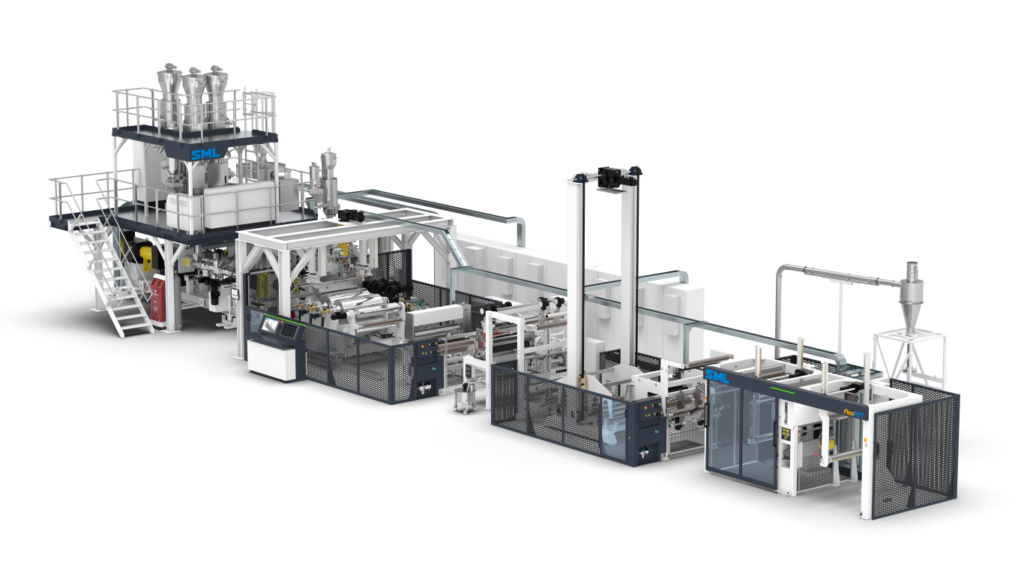
In April 2026, Austrian extrusion equipment manufacturer SML introduced its redesigned FlexiPET demonstration line, featuring the new TSE80 twin-screw extruder, an updated roll stack and the W650 winder. For thermoforming producers, the most interesting question is not simply how much PET sheet the line can produce. It is how consistently that sheet can be thermoformed into good products.
What Is New in SML’s FlexiPET Line?
SML describes FlexiPET as a production-scale demonstration line available at its Technology Centre in Redlham, Austria. The updated configuration combines a parallel co-rotating TSE80 twin-screw extruder, high-performance vacuum degassing, precision calendering and modular winding. It supports both three-layer A/B/A and two-layer A/B sheet structures.
| Specification | Manufacturer information |
|---|---|
| Maximum complete-line PET output | Up to 1,200 kg/h |
| TSE80 main extruder output | Up to 1,000 kg/h PET |
| TSE80 main drive | 348 kW |
| Co-extruder | ES 60/28D, up to 200 kg/h PET |
| Sheet structures | A/B/A or A/B |
| Sheet thickness | 150–1,400 µm |
| Final net sheet width | Up to 1,000 mm |
| Maximum winding diameter | 1,500 mm |
| Maximum roll weight | 2,000 kg |
All figures above are published SML specifications for the demonstration line; actual performance depends on material and operating conditions.
1. TSE80: Material Flexibility and Melt Quality
According to SML, the TSE80 was developed in-house specifically for polyester processing. The parallel co-rotating twin-screw design is intended to handle low-bulk-density feedstocks such as flakes and regrind, as well as PETG and selected mixed material streams.
The extruder is combined with a two-stage vacuum system that SML says can reach an absolute pressure as low as 1 mbar. The system is designed to support PET processing without a separate pre-drying step under suitable conditions.
2. Sheet Thickness Variation Becomes Product Variation
Thermoforming starts with a sheet whose thickness profile is already established. Local thickness differences can affect heating response, material distribution and the resulting wall thickness of cups, trays and other formed parts.
For example, if a sheet’s nominal thickness is 600 µm but the transverse profile varies, cavities across the tool may not receive identical starting material. The forming process can amplify those differences, especially when the process window is narrow.
SML’s redesigned horizontal roll stack uses its Smart Parallel Gap (SPG) technology. Servo positioning and linear guides are intended to improve the reproducibility of roll-stack positioning, while production positions can be stored in the SMILE control system.
3. Recycled PET Requires a Stable Process Window
Using recycled PET can create additional variability in feedstock properties, contamination levels and thermal history. The FlexiPET configuration is designed for flexible use of virgin material, flakes and regrind, supported by gravimetric dosing.
For thermoforming operations, a material change should not be assessed by appearance alone. Heating behaviour, forming stability, clarity, dimensional consistency and scrap levels should be monitored during production trials.
- Compare incoming sheet thickness and roll-to-roll consistency.
- Record material formulation and recycled-content changes.
- Monitor oven settings, sheet temperature and forming response.
- Measure final product weight, wall distribution and reject rate.
- Verify that higher recycled content does not unintentionally reduce saleable output.
4. Extrusion and Thermoforming Must Be Evaluated Together
A thermoforming machine may appear to have a cooling, forming or handling problem when the root cause is inconsistent sheet. Conversely, excellent sheet cannot compensate for inadequate tool cooling, poor forming-air dynamics or incorrect machine-tool timing.
The most effective troubleshooting approach is to separate the process into measurable stages:
| Process stage | What to verify |
|---|---|
| Extrusion | Material dosing, melt stability, filtration and sheet profile |
| Heating | Sheet temperature distribution and repeatability |
| Forming | Plug timing, forming-air build-up, vacuum and material distribution |
| Cooling | Tool heat removal and dimensional stability |
| Final product | Weight, wall thickness, quality and saleable output |
5. Why a Better Sheet Can Improve Economics
Consider a simplified example: a line produces 1,000 kg of sheet per hour. If the downstream thermoforming process rejects 5% of material, the equivalent rejected mass is 50 kg/h. Reducing that rejection rate to 3% would represent a 20 kg/h reduction in rejected material, assuming the same input and product mix.
Improved sheet consistency may also support a more stable forming process, fewer adjustments and higher usable production capacity. These benefits should be verified with plant data rather than assumed from equipment specifications.
6. What Should Producers Test Before Investing?
SML makes the FlexiPET demonstration line available for trials and sample production. Such trials can be useful when they are designed around the requirements of the downstream thermoforming process.
- Test the actual material mix, including recycled-content targets.
- Measure sheet profile across the full usable width.
- Run representative thermoforming tools and product geometries.
- Compare cycle time, scrap rate and product weight at equal quality standards.
- Document process repeatability over longer production runs.
Final Thoughts: Good Thermoforming Starts Before Forming
SML’s redesigned FlexiPET line and TSE80 extruder demonstrate continued innovation in PET sheet extrusion, particularly in material flexibility, vacuum degassing and precision sheet production.
For thermoforming manufacturers, the wider lesson is clear: extrusion quality and thermoforming performance are connected. Stable sheet quality creates a stronger foundation for reliable heating, material distribution, cooling and production speed.
At Dobringer Thermoforming Consulting, the focus is on identifying the real bottlenecks between machine, material, tool and process—and translating technical improvements into measurable production results.
Fresh Eyes. Fast Impact.
Sources
SML – FlexiPET: redesigned demo line for PET thermoforming sheet (22 April 2026)
SML – Technology Centre and demonstration line specifications
Editorial note: This is an independent technical analysis based on publicly available manufacturer information and general process-engineering principles. It is not a performance test or endorsement of SML equipment by DTC.